Showing posts with label Art. Show all posts

Tod Temple: The Preciousness is in the Details

Pharaohs built their falcon-headed god of war multiple homes around the ancient city of Thebes. The god Montu rose to prominence in the Middle Kingdom at a time when the pharaohs made him their patron deity. Many pharaohs of this period were named Montuhotep, meaning "Montu is Satisfied" and he must have been very satisfied with the four temples built in his honour that marked the territory of, and protected, Thebes (modern Luxor). To the North was his house at Medamud. He had another just outside the north wall of Karnak temple. To the South, on the west bank of the Nile, the god lived at Armant; while on the east bank he also had a temple at Tod (pronounced 'toad').

One of the first modern visitors to Tod was Jean-Francois Champollion, who would become the decipherer of hieroglyphs and the Father of Egyptology. During his trip in 1828/29, Champollion investigated a 'crypt' that was engulfed by an Egyptian village. Almost a century later another Frenchman, Fernand Bisson de la Roque, cleared the village and began excavations to reveal two halls of the buried temple. The crypt that Champollion investigated and Bisson de la Roque cleared was beneath this chapel dedicated to the consorts of Montu: Tjenenyet and Ra'ttawy. On the walls, the pharaoh is depicted performing the holy rites for the goddesses.

In fact, the chapel was a mammissi, or birth house. At other sites, Dendara in particular, the mammissi was a separate building within the sacred precinct, but they were also built as chapels within a temple. Mammissi commemorated either the birth of the diety or the divine birth of the pharaoh, thus proving his divine right to rule. This special building or chapel appeared in the Ptolemaic period when the pharaohs, of Greek origin, had to prove their birthright. At Tod, the hippopotamus goddess Taweret waddles across the ways. She presided over fertility and childbirth. In her hands she holds what is thought to be a roll of cloth that is tied near one end. This is the hieroglyph sa that symbolized protection. Taweret protected mothers in childbirth and the household in general.

Although the temple is beautiful in its own right, perhaps the most fascinating aspect of a visit today is wandering through the storage area of decorated fragments that have not yet been restored to their proper place in the temple. French archaeologists are still working at the site and have arranged the blocks in groups of like pieces. They have before them a massive jigsaw puzzle and, in this case, each fragment is extraordinary in its own right.

It is in the blockyard that one can see evidence from what may have been the earliest temple at Tod. A slab of pink Aswan granite bears the cartouche of Userkaf, the first pharaoh of Egypt's fifth dynasty. Userkaf ascended the throne in c. 2494 B.C. and ruled for only seven years. Yet within that short space of time he constructed his pyramid at Sakara, a solar temple at Abusir and, perhaps, the temple of Montu at Tod.

The massive granite block was excavated at the site but archaeologists have not found any other evidence for an Userkaf temple. The first temple structure that they have direct evidence for was built by Mentuhotep II in 2050 B.C., some four centuries after Userkaf. It is possible that the block may have been moved from another site and reused at Tod. Unfortunately, no mention of Tod (ancient Djerty) or the god Montu has been preserved on the fragment. Such mention would have been proof positive that Userkaf built a temple here. So the question of the existence of an Userkaf temple remains for open for discussion.

Egyptian temples can be overwhelming when visitors try to comprehend the multitude of figures that are carved on any one wall. Viewing a fragment allows the beholder to appreciate the exquisiteness of the carving. For example, looking at the lion-headed goddess Sekhmet in her original position as a very small part of a complete temple wall, the viewer might easily overlook her regal whiskers, the tautness of her cheek, and the details of her crown. As a goddess of war and protector of pharaohs, she is a feminine compatriot of Montu. She and Montu also originated as solar deities, hence the sun disk crowning her head.

One corner of the blockyard is dedicated to carved architectural fragments from two churches built at the site. One dates to the 5th century A.D. The other was dedicated to Anba Ibshay, a local saint, and was destroyed in late medieval times.

In this section of the blockyard lies a beautiful lintel carved with the Coptic Cross. The cross is derived from the pharaonic ankh, symbol of life. Since the ankh is composed of a T cross with a circle on top, it was an easy step for early Christians to associate it with the eternal life promised by Christ. On the lintel block, the cross is placed inside a building which probably refers to the very church that the stone decorated.

Beneath a church and the Ptolemaic temple's flooring, in the foundation of the Middle Kingdom temple, French Egyptologist Fernand Bisson de la Roque discovered the Tod Treasure. Although the treasure contained silver, lapis lazuli and some gold bullion, the stone fragments that are lined up around the temple seem just as precious.


WHERE TO FIND ME


View Larger Map

The temple itself does not look as impressive from the satellite as it does with feet firmly placed on the earth. The small building in the upper left of the satellite image is Montu's barque shrine, originally built by Tuthmosis III but also bearing decoration from succeeding pharaohs. The square space to the right of the temple are the Roman period walls of the temple's sacred lake.

GETTING THERE USEFUL INFO SOURCES
Be sure to purchase an entry ticket at Luxor Temple before setting out for Tod. Tickets are not sold at the temple. Ticket price for a foreign adult is 25LE.

Head South for 5.6 km beyond the Luxor Bridge. There is a checkpoint at the turn for Tod village. Turn left (East) at the checkpoint and follow the road through the village and past the monastery. At the Y-intersection with a yellow mosque building in the center, turn right (West) and drive for another .3 km to the temple's entrance.

Egyptian Monuments blog by Su Bayfield, Tod
Tour Egypt website, The Temple of Montu at Tod in Egypt by Mark Andrews
Louvre Museum Collection 11th Dynasty Relief from the Temple of Monthu at Tod
Louvre Museum Collection The Tod Treasure

Deir el Shuhada: In Reverence of Martyrs

Diocletian ascended Rome's imperial throne in difficult times. Anarchy of the third century A.D. had enabled invasions by Goths, Visigoths, Vandals and others, fueled civil wars that split the empire into three competing states, and fostered economic hardship through hyperinflation and the breakdown of once-prosperous trade networks. The empire was crumbling and it seemed to Diocletian that the moral fabric of his people was crumbling too.

With authoritarian single-mindedness he set out to rectify the empire's problems. To fix the administration of the empire he created the Rule of the Four (Tetrarchy); to fix the economy, he instituted wage and price controls, and to fix the moral fabric of the people he promoted "pious, religious, peaceable and chaste life" through veneration of the traditional Olympian gods and elimination of religious minorities. Beginning in 303 until his retirement in 305, Diocletian oversaw the worst persecution of Christians across the empire. It was most brutal in Egypt where more than half a million men, women and children are estimated to have been killed.

To mark the momentous suffering, Year 1 of the Coptic calendar is 284 A.D., the first year of Diocletian’s rule. Hence, 2011 corresponds to 1728 A.M (Anno Martyri – Year of the Martyrs). Moreover, martyrdom remains a significant cornerstone of Coptic faith. Copts honour those who die because of their faith, as seen in the martyrdom of those killed on Christmas Eve 2010 in Nag Hamadi and whose portraits appear on postcards recently seen in Luxor. It was with this background that an excursion to Deir el Shuhada, the Monastery of the Martyrs, located at the desert's edge near the city of Esna, was made.

In the first centuries A.D., Esna had a significant Christian population. A monk named Ammonius was ordained their bishop in the early years of fourth century as Diocletian's persecution was raging. Perhaps in the year 307 A.D., Ammonius took his congregation to the monastery of St. Isaac the Hermit, located in the mountains West of Esna, to celebrate the saint's feast day. Diocletian's appointed governor for the area, Arianus, followed with his troops and killed the congregation, said to number 160,000 people. Ammonius was arrested and tortured but would not recant his faith. Instead, he prophesized that Arianus himself would embrace Christianity and be martyred. With that, Ammonius was put to death. Remains of "innumerable bodies" found in a mass grave about three kilometres West of Esna, at a location that corresponds with the monastery of St. Isaac, provided tangible proof of the persecution.

The Monastery of the Martyrs is also known as Deir el Manawus, the Monastery of Ammonius. Tradition states that Ammonius built the monastery in the early fourth century but, as yet, there is no evidence for such an early date. Another tradition says that Queen Helena built the monastery to commemorate the martyrs. Today, there are two churches within the monastery which has been re-newed and re-inhabited by nuns. The newest church, dedicated to the Virgin and built in 1931, was required to hold the growing congregation that visits the monastery from the surrounding villages as well as pilgrims coming from further afield.

Copts do not worship saints. In fact, such worship is forbidden. Icons are "windows to heaven". The faithful pray before an icon to honour the life and deeds of the saint and to ask for the saint's intercession with God and Christ to help them in their daily lives. Prayers are often accompanied by the lighting of a candle placed before the icon. Appeals for help are also written on scraps of paper and slipped behind the glass that fronts the saint's image, as here before Saint George in the new Church of the Virgin at Deir el Shuhada.

Written appeals have a long tradition. In the older Church of the Martyrs prayers to Saint Theodore are preserved on the fragmentary plastered walls which probably date to the 11th or 12th century.

On the opposite wall rides another warrior saint, Saint Claudius.

Brooklyn Museum - Early Christian (Coptic) Monastery at Esna - Edwin Howland Blashfield
In ca. 1887, Edwin Blashfield visited the Church of the Martyrs and was able to provide a more wide-angle view of the sanctuary with a pencil than I could capture digitally. His drawing captures the central and southern haykals dedicated to the Holy Virgin and the Holy Martyrs of Esna, respectively.

No doubt, Blashfield saw more than meets the eye today. Some restoration work has taken place recently to stop further plaster fragments from falling off the mud-brick walls. Lacuna in the painted plaster emphasize the preciousness of the images that remain.

The concha (semidome) of the apse bears an image of Christ in Majesty. He sits within a mandorla symbolizing spiritual power or the transition of heaven and earth. He holds a codex in his left hand and raises his right hand in blessing. On the inner curve of the arch Saint Peter holds two keys in his left hand and points to them with his right. 

Below the dome is an image of the Virgin and Child (barely visible) sitting on a throne flanked by the archangels Michael and Gabriel, who hold orbs. A red cloth with white crosses covers the altar in the centre of the chapel. Time has faded, abraded and soiled the images but it has not hidden their glory.

The visit to the Monastery of the Martyrs was most enjoyable and enlightening. Worshipers welcomed us, shared sacramental bread, and proudly guided us around their monastery. Leaving, one of the nuns who now inhabit the monastery waved good-bye and locked the door behind her as has been done in centuries previous. They are reviving the monastic life inspired by the teachings of the fourth and fifth centuries. They "are social martyrs who have sacrificed their life in the world for an existence of worship and total dedication to the rules of the Church." (van Doorn-Harder, p. 17)


WHERE TO FIND ME


View Larger Map
Arriving at Deir el Shuhada by car, rather than by balloon from on high, I had no concept of the vastness of the cemetery that stretches to the West of the church complex. The satellite imagery from Google Maps provides a widened dimension of understanding of the monastery's context.

GETTING THERE USEFUL INFO SOURCES
Cross the Nile at Luxor to the West Bank and turn left (South) on the Luxor-Esna highway. Some 46 km after the checkpoint and before arriving in Esna, there is a road on the right that leads off the highway to the West. This is a ring road that avoids the city's traffic jams. After 8 km turn right (West) at an intersection that takes you over the sugarcane railway tracks and onto a gravel road. Drive another 2 km and you will see the monastery on the left hand side. Christianity and Monasticism in Upper Egypt by Gawdat Gabra and Hany N. Takla: Chapter 10: Esna Martyrs, pages 95-104
Encyclopedia Coptica: The Christian Coptic Orthodox Church Of Egypt
Claremont Coptic Encyclopedia article: Dayr Al-Shuhada'
Nelly van Doorn-Harder article: Imagined Antiuqity: Coptic Nuns Living Between Past Ideals and Present Realities

Secrets Unveiled at Dendara

 In wanton imitation of Dr. Hawass, who has achieved literary fame with an untold number of 'secret' articles and at least five 'secret' books (Secrets from the Sand, Secrets of the Pharaohs, Secrets of the Sphinx, Zahi Hawass's Secret Egypt: A Travel Guide, and the ultimate, limited edition A Secret Voyage: Love, Magic and Mysteries in the Realm of the Pharaohs selling for a princely $4,400), I bring to my dear readers the secrets of Dendara as unveiled to me on a recent Travel Tuesday.

Although I had visited Hathor's temple at least twice before, this visit proved that repeat visits can be as exciting as the first. Setting out early from Luxor, I had no idea what wonderful surprises were in store.

The first surprise was immediate upon our arrival. A new visitors centre has been built offering a very comfortable, air-conditioned theatre in which to watch an interesting introduction to the temple and its rites. It also offers the more mundane, but necessary, toilets -- for the price of a 1LE tip to the attendant. For all his (well-known) faults, Dr. Hawass must be credited for the creation of this and other visitor centres and small site museums across the country. They enrich the experience of visiting Egypt's extraordinary monuments.

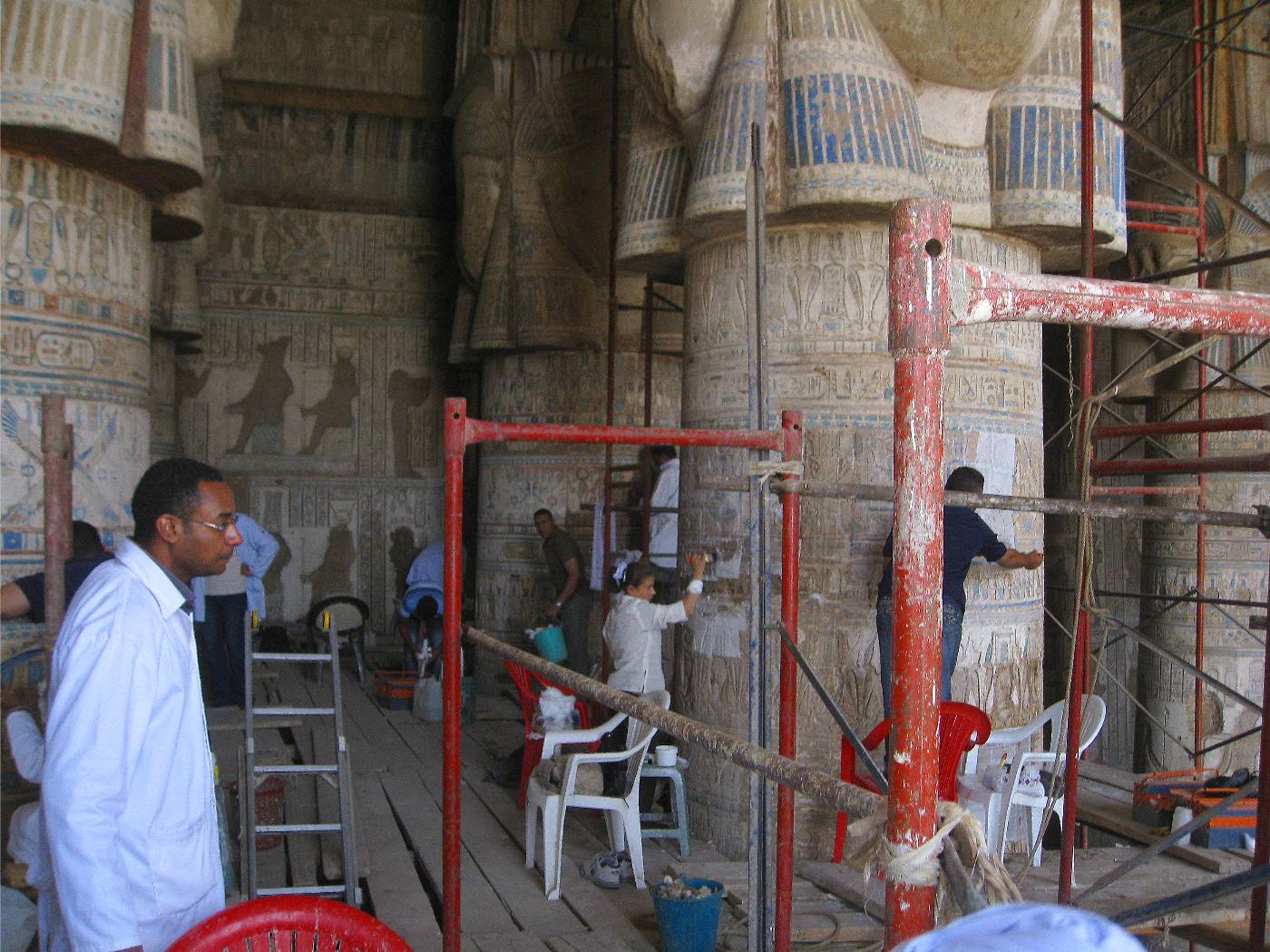
The second and more astonishing surprise also credits Dr. Hawass' leadership of the Supreme Council of Antiquities (now Ministry of Antiquities). Upon entering Hathor's temple, brightness and colour radiate all around its hypostyle hall, as does the din of the work of a large team of Egyptian conservators who are cleaning the ceiling, walls and columns. Dendara temple has long been famous for its "profuse and mysterious" decorations and Amelia Edwards, travelling A Thousand Miles Up the Nile in 1873-74, was "bewildered" by what she saw. She wrote,
. . . dimly visible on every wall, pillar, and doorway, a multitude of fantastic forms -- hawk-headed, ibis-headed, cow-headed, mitred, plumed, holding aloft strange emblems, seated on thrones, performing mysterious rites -- seem to emerge from their places, like things of life. Looking up to the ceiling, now smoke-blackened and defaced, we discover elaborate painting of scarabaei, winged globes, and zodical emblems divided by border of intricate Greek patterns, the prevailing colours of which are verditer and chocolate. (page 124)
I can only imagine Amelia's awe should she have the opportunity to look heavenwards now. The sooty veil that once concealed Hathor's loveliness has been lifted. As a result of the SCA's work, the monument is breathtaking. The hypostyle hall was built in 36 AD, during the reign of Emperor Tiberius. The walls show Tiberius, and his successors Nero and Claudius, presenting offerings to the goddess.

The goddess Nut (pronounced 'Newt') stretches across breadth of the hall's ceiling. She arches her body over the earth and her fingers and toes touch the four cardinal points. She is the embodiment of the dome of the night sky and across her body the stars float on their boats. She swallows the winged sun disc every night . . .

. . .  in order to give birth to it every dawn. From floor level, more than 25 m below, the detail of Nut's beaded gown is clearly visible.

The ceiling is supported by 24 Hathor-headed sistrum-capitals. The sistrum was a sacred musical instrument, similar to a rattle or tambourine, that made noise when it was shaken during religious ceremonies. It became the sacred image of the goddess herself. With purposeful determination, the features of all four faces of the column were brutally hacked away by early Christian fanatics who feared the power of the goddess -- she who personified the principles of love, beauty, music, motherhood, and joy. By literally defacing her, they stripped her of her magical energy.

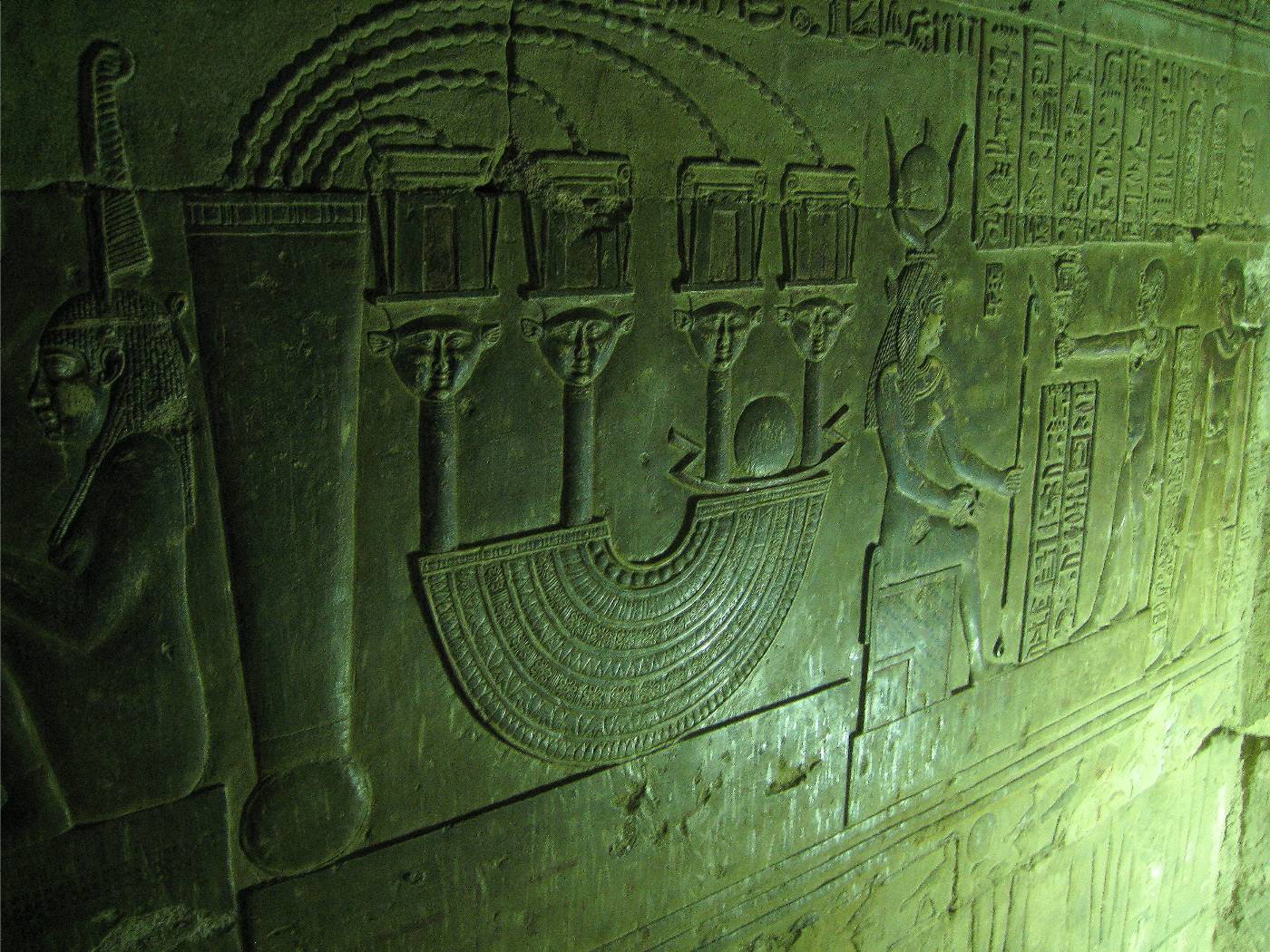
After the surprise from above, there was a surprise from below. Temple priests stored Hathor's treasures in a crypt at the rear of the temple. An open invitation to descend was a new opportunity for me. Visiting the crypt requires an intake of breath as one crawls through a narrow opening at the base of a wooden ladder, but once inside the narrow underground passage is high enough to stand in. The beautiful carvings make the effort to beat back feelings of claustrophobia well worthwhile.

The depiction of the goddess' sacred menat necklace details the heavy semi-circular pectoral that hung from four sistra pendants. Chains attached to these pendants linked the necklace with its counterweight that hung down the back of the wearer. The necklace on the wall probably reproduces the actual necklace worn during the temple's holy rites and one of the most important objects stored underground.

The other sacred object stored in the crypt was a statue of Hathor's ba (or soul, for lack of a better translation). Every year, the priest carried the statue up to the temple roof to celebrate the New Year's festival. At sunrise, the goddess was raised aloft in symbolic union with the solar disc Atum. Even after several visits to the temple, climbing those same steps alongside the priests is a pretty awesome experience. Time contracts as the priests and the visitor ascend the dark staircase together into the dazzling sunlight. 

Dendara has always been one of the most important temples on the Egyptian tour itinerary because it is one of the best preserved. The ongoing work of Egypt's Supreme Council of Antiquities ensures that with each visit further secrets will be revealed.


WHERE TO FIND ME


View Larger Map
The satellite image clearly shows the temple surrounded by its massive mud-brick enclosure walls that delineated the sacred precinct. Also visible, in the left-hand corner are the palm trees that now grow in what was the temple's sacred lake.

GETTING THERE USEFUL INFO SOURCES
We drove to Dendara along the western desert 'highway'. As I mentioned to my parents, do not expect this to be HWY 401. I'm afraid I did not keep track of the mileage and the various turns, but Dendara is a well known site and is located directly across the Nile from the city of Qena so all taxi drivers will know how to get there. Egyptian Monuments blog:
Dendera
Tour Egypt article: Dendera and the Temple of Hathor by Mark Andrews
Living in Luxor article: Trips to Dendera and Abydos

Qus: A Town of Distinction

Tuesday morning streets in Qus teem with pedestrians, carts and vehicles. It's market day and the street melange might strike the visitor as rather chaotic but no one else seems to notice. This is their daily life. There are goods to be bought and sold, prices to be argued, news to be exchanged, politics to be discussed and chickens to be butchered. All of this takes place to the somewhat discordant chorus of car horns in the narrow streets of this medieval city.

In fact, the scene today is probably not too dissimilar from the tenth century when this town rose to prominence as Egypt's second most important city, after Cairo. And it remained key for six hundred years thanks to its pivotal location on the trade route between East and West. All goods from India and Arabia that passed through Qus on their way to Mediterranean markets until 1498 when Vasco de Gama discovered an alternative sea-route around Africa.


That trade brought Qus much prominence and wealth, which explains why in this backwater town of modern times you will find the most important medieval monument in Upper Egypt. Al Amri Mosque was founded in 1083 and many sultans and pashas added to its splendor over the centuries.

The mosque has an open enclosure plan featuring arcades of columns surrounding a large opening in the roof to fill the building with light and air. Surprisingly, the cacophony from the street seems to stay outside the walls.

The original builders reused columns and capitals from some unknown Roman monument built by some distinguished official in a town that commanded an important position in the transfer of granite and marble to the imperial courts in Rome and Byzantium. Under the arcade, or riwaq, Moslems gather to hear the imam's sermon and to pray.

The riwaq and the qibla wall are the only surviving elements of the original Fatimid mosque. The arched mihrab indicates for Moslems the direction of the Kaaba in Mecca so that they can orient themselves correctly for their daily prayers.

The mihrab's interior is decorated with magnificently intricate stucco work that dates to the Mamluk period (1250–1517). The Quranic inscription that frames the arabesque design in the centre is written in Thuluth script. This style of calligraphy was revolutionary in the eleventh century because it replaced the straight block letters of Kufic script. Thuluth's letters flow in a cursive style because one third of each letter is curved.

The imam reads the weekly sermon from a stepped platform, called a minbar. Al Azmi's minbar is of intricately carved wood and is one of the oldest in Egypt. The Fatimid vizier al-Salih al-Tala'i presented this magnificent podium to the mosque in 1155 when he governed Qus. He later went on to build his famous mosque in Cairo. The Quranic inscription that graces the lintel over the platform's entrance is written in the block-like Kufic script. The seemingly incongruous microphone at the top of the stairs shows that the minbar remains integral to the mosque's current use.

Every inch of the minbar's teak exterior is intricately carved in complex geometric and vegetal patterns. Islam's prohibition of idolatry forbids the creation of images of God, the Prophet Mohamed and other living beings, giving rise to amazing non-figural art to decorate their houses of worship.

The riwaq, mihrab and minbar are all spectacular but scholars of Islamic architecture distinguish al-Azmi Mosque as the most important medieval monument in Upper Egypt because of the architecture of the dome over the tomb of Mubarak bin Maqlid. Built in 1172, the architect devised an elaborate system of squinches to make the transition between the four-sided room and its domed roof. The dome's six-pointed stars with tear-shaped openings above are quite unique.

Al-Azmi Mosque provides a peaceful place for contemplation of the divine. Across the square is a reminder that secular economic activities enabled the creation of that peace. Quite distinct from the quiet of the mosque is the hustle and bustle of the wakala. Protected behind its strong door, traders stored their goods and housed their animals on the lower level and rented rooms above.

Its exterior brick and woodwork are well maintained. Inside, the balconies are shaky and rooms lack roofs but the building continues to be part of the city's economic life as it is home of a metalworking shop. Although Qus has declined from its high point as Egypt's second city, it remains economically vibrant and a town of distinction. Well worth a visit!


WHERE TO FIND ME


View Larger Map
The large roof with an opening to the sky distinguishes Al Azmi Mosque amid the complicated matrix of other buildings in the center of Qus.

GETTING THERE USEFUL INFO SOURCES
Drive North on the Luxor-Qena highway. Approximately 30 km from Luxor turn East at the well-marked turn-off for Qus. This road becomes Al Nasr street. Some 3.4 km from the highway, turn left. It is almost a straight shot to reach al-Azmi Mosque but it is best to begin asking directions once you turn off Al Nasr street.

I was told that a entry ticket is usually sold to visitors, however none were available on the day that I visited. In lieu of a ticket, a tip to the man who guards the shoes at the door and LE 20 to the unofficial guide was happily accepted. Simply ask to take a peak inside the wakala. Access to the upper floors is not advisable, but it's worth a look.
Pergamon Museum, Berlin, has a 12th century wood panel from al-Azmi Mosque: Collection of the Museum of Islamic Art

Deir Mari Girgis el Ballas: A Holy Modern Masterpiece

Spirits soar in the bleak desert. Its desolation is alive with holy asceticism. In a 50-km drive on the desert highway North of Luxor, we pass three monasteries and there are said to be seven others in close proximity. On this trip to see the potters at El Ballas, we turn into the small monastery of St. George. As with most Coptic churches, the exterior is extremely plain belying the magnificence of its interior.

Its nave is roofed with 21 cupolas, a design feature of Coptic church architecture that arose due to a lack of wood in Egypt. Entering, I was floored by the power of the images gracing the domes. Each cupola tells two stories. All of the images are dated to 2007 and all are painted by maestro Samy Henes. In a country with high illiteracy rates, I could easily imagine monk priests referring to the images high above the seated faithful during their sermons. Certainly, the images radiate with the power of the stories.

As Jesus' first miracle, the wedding at Cana is celebrated with a minor feast in the Coptic church. In their ancient calendar, it is celebrated on Tobah 13, which is approximately January 12th. Copts believe "Our Lord changed the water into wine, as His first miracle, at the wedding in Cana of Galilee, confirming His eagerness for our attaining the heavenly wedding, and granting us the wine of His exceeding love."

 
Monasticism was born in Egypt. From the 5th century A.D. onwards several monastic communities were established in the desert, particularly here in Upper Egypt. Certainly the image of Jacob's ladder would inspire the monks. For just as Jacob exclaimed so might they: "Surely, the Lord is in this place, and I did not know it! I thought that I was all alone, but God has been with me. This place is the house of God; it is the gate of heaven!" (Book of Genesis 28)  Furthermore, since at least the third century A.D., Jacob's ladder is interpreted as the ascetic ladder that the soul climbs on Earth, with the steps representing increasing virtue used to ascend to heaven.

Christ is enthroned in majesty within the central copula. To me, the world seems to weigh somewhat heavy in His hand.

He is encircled by the popes of the Coptic Orthodox Church of Alexandria, each one recognizable. The current pope, His Holiness Pope Shenouda III, chose to live in the solitude of the desert as a monk when he was 31 and he has been instrumental in reviving Coptic monasticism since the 1970s. Hundreds of young men and women have reestablished monasteries and convents the length of Egypt. In the bleakness of the desert, their faith blooms.

WHERE TO FIND ME


View Larger Map


GETTING THERE USEFUL INFO SOURCES
Drive North from the main West Bank checkpoint to the sign indicating a left turn to Sheikh Tayb Saha village. Follow this road out to the desert Luxor-Qena highway. You will pass the large monastery of St. George on east side of the road and the domes of Deir el Malek on the west side. After 44.5 km from entering the desert, the entrance to the modern monastery of St. George at el Ballas is located close to the highway. Coptic Church website: Coptic Orthodox Church Network
Artist Samy Henes' website: Welcome
Wikipedia article: Coptic Architecture
Tour Egypt article: The Christian Monasteries Near Naqada by Jimmy Dunn

Medamud: Past-Present Continuum Revealed


A procession of corpulent male deities and busty female deities parade before me. Each one comes to the god’s house bearing gifts from their region. Some bring grain; others cattle, precious metal dishes, libations or incense.


 Glancing over the head of a goddess that herds goats before the god, I spy their modern descendants jumping over the ruins of the god’s house. Past and present become contemporaneous.


It is a quiet morning at the house of Montu, god of war. The only visitors are me, the goats, and a few antiquities guards, called gawfeers in Arabic. Montu has had a temple at Medamud, located about 8km North of Luxor, since the Middle Kingdom. Four millennia have passed and relatively little of the temple remains visible. Correlating the guidebook's plan with bits of walls on the ground poses a challenge. Medamud is in ruin. Perhaps this is why the site is not open for visitation except by request. But step forward. Narrow the eyes’ focus to the preserved details. Exquisite splendor is revealed. It is well worth asking the Karnak inspectorate chief for permission to visit.


Egyptian temples represent a microcosm of the universe. The carving that covers every inch of its surface conveys the sensitivity of the artists to their universe. Ducks flutter above an offering tray. New shoots bend in the breeze. A dado of papyrus buds and blossoms around the temple's inner walls recreates the mound of creation from which all life was born.


And in this universe, men play the harp and women dance with castanets. The countless hieroglyphs record a hymn: “The priest honours You with his basket, And the drummers take their tambourines. Ladies rejoice in Your honor with garlands, And girls do the same with wreaths.”


I conclude my visit with a walk along the Avenue of Sphinxes to the quay. From here Montu, carried by priests, boarded his sacred barque and traveled along the canal to his residence at Karnak. Here, too, worshippers disembarked bearing alms for their falcon-headed lord. I looked down and found graffiti footprints of some nameless ancient. Carved as an act of personal piety to express eternal devotion, the prints match my own. Once again, past and present converge at Medamud.


WHERE TO FIND ME


View Larger Map

GETTING THERE USEFUL INFO SOURCES
Driving out of Luxor on Airport Road, turn North towards Qena. After 5.5 km along the Qena Road, turn West on a small road that crosses the canal and the narrow gauge railway for sugarcane harvest. The village of Nag al-Medamud is just ahead. At the first T-intersection, turn left. At the next T-intersection, turn right. Drive past the goats in the village square and you see the temple of Montu in front of you. Drive along the temple's north side where you will see the gawfeer's hut. Egyptian Monuments blog:
Medamud
Tour Egypt article: The Temple of Montu, Rattawy and Harpocrates at Medamud
Archaeology of Ancient Egypt: Medamud
Musee des Beaux Arts, Lyon: Kiosk Gate from a Temple at Medamud
Luxor News blog: Medamud temple, north of Luxor
Neferuhethert: Hymn from Ptolemaic Temple at Medamud