Showing posts with label Coptic. Show all posts

Deir el Shuhada: In Reverence of Martyrs

Diocletian ascended Rome's imperial throne in difficult times. Anarchy of the third century A.D. had enabled invasions by Goths, Visigoths, Vandals and others, fueled civil wars that split the empire into three competing states, and fostered economic hardship through hyperinflation and the breakdown of once-prosperous trade networks. The empire was crumbling and it seemed to Diocletian that the moral fabric of his people was crumbling too.

With authoritarian single-mindedness he set out to rectify the empire's problems. To fix the administration of the empire he created the Rule of the Four (Tetrarchy); to fix the economy, he instituted wage and price controls, and to fix the moral fabric of the people he promoted "pious, religious, peaceable and chaste life" through veneration of the traditional Olympian gods and elimination of religious minorities. Beginning in 303 until his retirement in 305, Diocletian oversaw the worst persecution of Christians across the empire. It was most brutal in Egypt where more than half a million men, women and children are estimated to have been killed.

To mark the momentous suffering, Year 1 of the Coptic calendar is 284 A.D., the first year of Diocletian’s rule. Hence, 2011 corresponds to 1728 A.M (Anno Martyri – Year of the Martyrs). Moreover, martyrdom remains a significant cornerstone of Coptic faith. Copts honour those who die because of their faith, as seen in the martyrdom of those killed on Christmas Eve 2010 in Nag Hamadi and whose portraits appear on postcards recently seen in Luxor. It was with this background that an excursion to Deir el Shuhada, the Monastery of the Martyrs, located at the desert's edge near the city of Esna, was made.

In the first centuries A.D., Esna had a significant Christian population. A monk named Ammonius was ordained their bishop in the early years of fourth century as Diocletian's persecution was raging. Perhaps in the year 307 A.D., Ammonius took his congregation to the monastery of St. Isaac the Hermit, located in the mountains West of Esna, to celebrate the saint's feast day. Diocletian's appointed governor for the area, Arianus, followed with his troops and killed the congregation, said to number 160,000 people. Ammonius was arrested and tortured but would not recant his faith. Instead, he prophesized that Arianus himself would embrace Christianity and be martyred. With that, Ammonius was put to death. Remains of "innumerable bodies" found in a mass grave about three kilometres West of Esna, at a location that corresponds with the monastery of St. Isaac, provided tangible proof of the persecution.

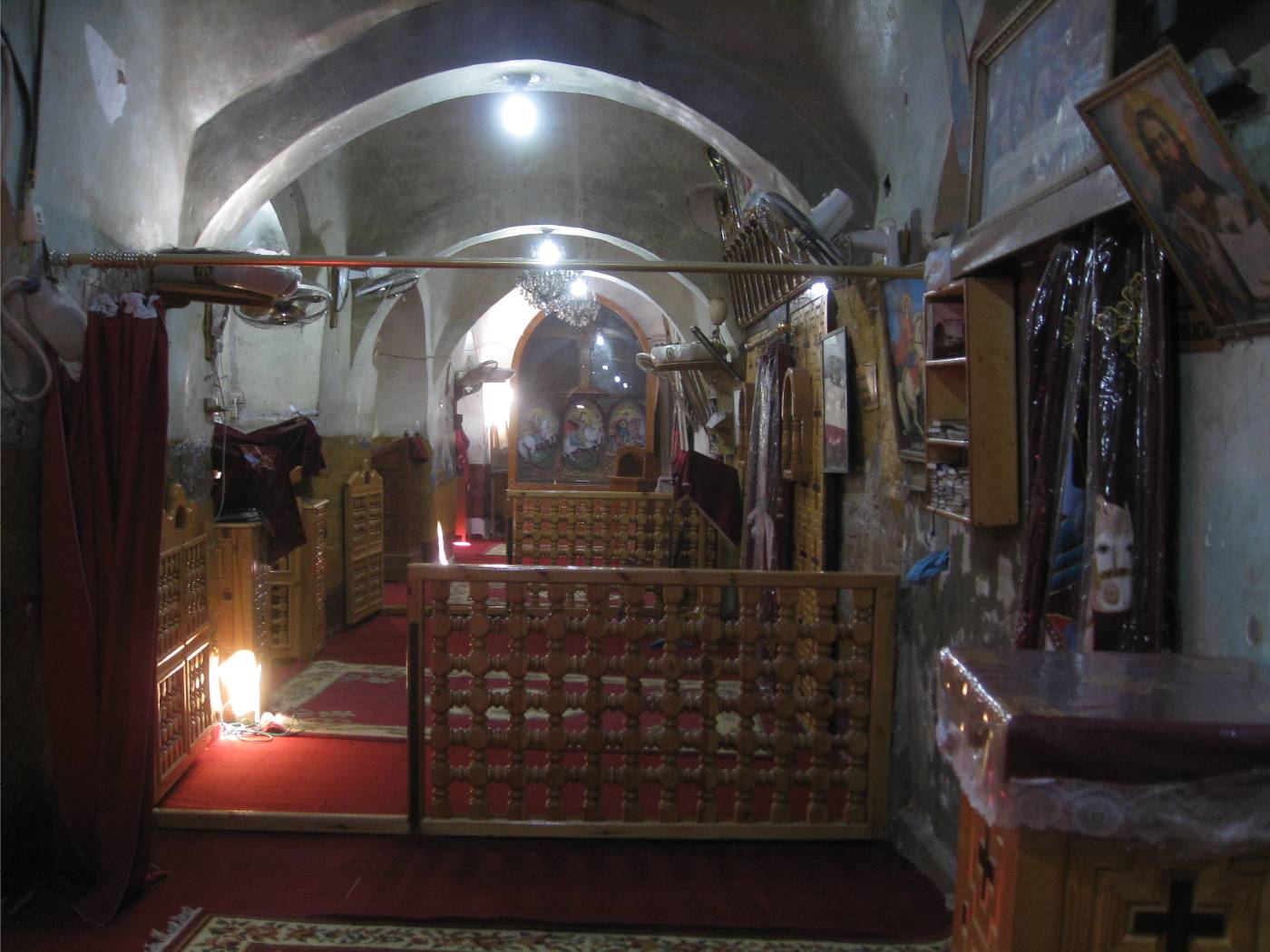
The Monastery of the Martyrs is also known as Deir el Manawus, the Monastery of Ammonius. Tradition states that Ammonius built the monastery in the early fourth century but, as yet, there is no evidence for such an early date. Another tradition says that Queen Helena built the monastery to commemorate the martyrs. Today, there are two churches within the monastery which has been re-newed and re-inhabited by nuns. The newest church, dedicated to the Virgin and built in 1931, was required to hold the growing congregation that visits the monastery from the surrounding villages as well as pilgrims coming from further afield.

Copts do not worship saints. In fact, such worship is forbidden. Icons are "windows to heaven". The faithful pray before an icon to honour the life and deeds of the saint and to ask for the saint's intercession with God and Christ to help them in their daily lives. Prayers are often accompanied by the lighting of a candle placed before the icon. Appeals for help are also written on scraps of paper and slipped behind the glass that fronts the saint's image, as here before Saint George in the new Church of the Virgin at Deir el Shuhada.

Written appeals have a long tradition. In the older Church of the Martyrs prayers to Saint Theodore are preserved on the fragmentary plastered walls which probably date to the 11th or 12th century.

On the opposite wall rides another warrior saint, Saint Claudius.

Brooklyn Museum - Early Christian (Coptic) Monastery at Esna - Edwin Howland Blashfield
In ca. 1887, Edwin Blashfield visited the Church of the Martyrs and was able to provide a more wide-angle view of the sanctuary with a pencil than I could capture digitally. His drawing captures the central and southern haykals dedicated to the Holy Virgin and the Holy Martyrs of Esna, respectively.

No doubt, Blashfield saw more than meets the eye today. Some restoration work has taken place recently to stop further plaster fragments from falling off the mud-brick walls. Lacuna in the painted plaster emphasize the preciousness of the images that remain.

The concha (semidome) of the apse bears an image of Christ in Majesty. He sits within a mandorla symbolizing spiritual power or the transition of heaven and earth. He holds a codex in his left hand and raises his right hand in blessing. On the inner curve of the arch Saint Peter holds two keys in his left hand and points to them with his right. 

Below the dome is an image of the Virgin and Child (barely visible) sitting on a throne flanked by the archangels Michael and Gabriel, who hold orbs. A red cloth with white crosses covers the altar in the centre of the chapel. Time has faded, abraded and soiled the images but it has not hidden their glory.

The visit to the Monastery of the Martyrs was most enjoyable and enlightening. Worshipers welcomed us, shared sacramental bread, and proudly guided us around their monastery. Leaving, one of the nuns who now inhabit the monastery waved good-bye and locked the door behind her as has been done in centuries previous. They are reviving the monastic life inspired by the teachings of the fourth and fifth centuries. They "are social martyrs who have sacrificed their life in the world for an existence of worship and total dedication to the rules of the Church." (van Doorn-Harder, p. 17)


WHERE TO FIND ME


View Larger Map
Arriving at Deir el Shuhada by car, rather than by balloon from on high, I had no concept of the vastness of the cemetery that stretches to the West of the church complex. The satellite imagery from Google Maps provides a widened dimension of understanding of the monastery's context.

GETTING THERE USEFUL INFO SOURCES
Cross the Nile at Luxor to the West Bank and turn left (South) on the Luxor-Esna highway. Some 46 km after the checkpoint and before arriving in Esna, there is a road on the right that leads off the highway to the West. This is a ring road that avoids the city's traffic jams. After 8 km turn right (West) at an intersection that takes you over the sugarcane railway tracks and onto a gravel road. Drive another 2 km and you will see the monastery on the left hand side. Christianity and Monasticism in Upper Egypt by Gawdat Gabra and Hany N. Takla: Chapter 10: Esna Martyrs, pages 95-104
Encyclopedia Coptica: The Christian Coptic Orthodox Church Of Egypt
Claremont Coptic Encyclopedia article: Dayr Al-Shuhada'
Nelly van Doorn-Harder article: Imagined Antiuqity: Coptic Nuns Living Between Past Ideals and Present Realities

An Empress and a Saint in the Desert

A widow well in her seventies travelled through the mountains and deserts of the Middle East looking for relics of her faith. Her discoveries led to her being chosen as the patron saint of archaeologists. This intrepid traveller, famed for finding pieces of the True Cross, was Flavia Iulia Helena Augusta, the mother of Emperor Constantine. With unlimited access to the Roman treasury, she built the Church of the Nativity in Bethlehem, the Church on the Mount of Olives, the Church on Mount Sinai and, it is said, the first monastery in the desert near the Valley of the Queens.

The monastery was dedicated to Saint Tawdros (Theodore), an officer in the Roman army under the Emperor Diocletian. Refusing the emperor's demand to worship Apollo, he was affixed to a tree with 153 nails. Honoured as a saint  in the Orthodox and Catholic churches, the Coptic Church celebrates his martyrdom on the 12th of Toba (the fifth month of the Coptic calendar). At the desert monastery near Luxor, the Saint is worshipped as El Mohareb, The Warrior. Following the iconography of many warrior saints, he appears in full military garb upon his rampant steed.

The original monastery built by St. Helena was demolished in the eleventh century. At some unspecified time later, the Saint appeared in a dream to the local governor and asked that the monastery be rebuilt. By this point in time, the previous monastery's existence had been forgotten so the Saint had to lead the governor to the site. Some of the blocks used to build the sanctuary have been recycled from a pharaonic temple, perhaps from nearby Medinat Habu, thus Coptic crosses were carved over upside down hieroglyphs.

Except for the presence of electricity that powers the water pump and the shrine's lamps, a visit to the monastery of Saint Tawdros feels very ascetic. On this particular Tuesday, we were the only visitors until the arrival of an important church official and six engineers who came to discuss the renewal of the church.

Behind the monastery lies a Coptic cemetery. The dead are clothed entirely in white, including a head scarf, gloves, and stockings. They are carried to the burial in a funeral bier and then lowered into tombs carved into the bedrock. Small entry pits give access to a wider chamber where several bodies are laid side by side. When the tomb is full, the chamber is sealed with bricks or a metal door and the pit is filled in. There are no markers. So very different from the gold tiled tomb and red granite sarcophagus of Empress Helena in Rome and the Vatican Museum.

But most certainly she would be pleased with the peacefulness and sanctity of the place.


WHERE TO FIND ME


View Larger Map
The vastness of the cemetery outside the monastery's walls is seen clearly in the satellite image.

GETTING THERE USEFUL INFO SOURCES
Drive past the West Bank Antiquities ticket office on route to the Valley of the Queens. At the small police checkpoint there is a signed desert track leading to the monastery. The track runs close to the rear wall of Medinat Habu. Reflections in the Nile Blog, Palm Sunday Experience at St. Tawdros Monastery
Slideshow by CopticPower Coptic Monastery near Luxor - Thederos el Mohareb

Deir Mari Girgis el Ballas: A Holy Modern Masterpiece

Spirits soar in the bleak desert. Its desolation is alive with holy asceticism. In a 50-km drive on the desert highway North of Luxor, we pass three monasteries and there are said to be seven others in close proximity. On this trip to see the potters at El Ballas, we turn into the small monastery of St. George. As with most Coptic churches, the exterior is extremely plain belying the magnificence of its interior.

Its nave is roofed with 21 cupolas, a design feature of Coptic church architecture that arose due to a lack of wood in Egypt. Entering, I was floored by the power of the images gracing the domes. Each cupola tells two stories. All of the images are dated to 2007 and all are painted by maestro Samy Henes. In a country with high illiteracy rates, I could easily imagine monk priests referring to the images high above the seated faithful during their sermons. Certainly, the images radiate with the power of the stories.

As Jesus' first miracle, the wedding at Cana is celebrated with a minor feast in the Coptic church. In their ancient calendar, it is celebrated on Tobah 13, which is approximately January 12th. Copts believe "Our Lord changed the water into wine, as His first miracle, at the wedding in Cana of Galilee, confirming His eagerness for our attaining the heavenly wedding, and granting us the wine of His exceeding love."

 
Monasticism was born in Egypt. From the 5th century A.D. onwards several monastic communities were established in the desert, particularly here in Upper Egypt. Certainly the image of Jacob's ladder would inspire the monks. For just as Jacob exclaimed so might they: "Surely, the Lord is in this place, and I did not know it! I thought that I was all alone, but God has been with me. This place is the house of God; it is the gate of heaven!" (Book of Genesis 28)  Furthermore, since at least the third century A.D., Jacob's ladder is interpreted as the ascetic ladder that the soul climbs on Earth, with the steps representing increasing virtue used to ascend to heaven.

Christ is enthroned in majesty within the central copula. To me, the world seems to weigh somewhat heavy in His hand.

He is encircled by the popes of the Coptic Orthodox Church of Alexandria, each one recognizable. The current pope, His Holiness Pope Shenouda III, chose to live in the solitude of the desert as a monk when he was 31 and he has been instrumental in reviving Coptic monasticism since the 1970s. Hundreds of young men and women have reestablished monasteries and convents the length of Egypt. In the bleakness of the desert, their faith blooms.

WHERE TO FIND ME


View Larger Map


GETTING THERE USEFUL INFO SOURCES
Drive North from the main West Bank checkpoint to the sign indicating a left turn to Sheikh Tayb Saha village. Follow this road out to the desert Luxor-Qena highway. You will pass the large monastery of St. George on east side of the road and the domes of Deir el Malek on the west side. After 44.5 km from entering the desert, the entrance to the modern monastery of St. George at el Ballas is located close to the highway. Coptic Church website: Coptic Orthodox Church Network
Artist Samy Henes' website: Welcome
Wikipedia article: Coptic Architecture
Tour Egypt article: The Christian Monasteries Near Naqada by Jimmy Dunn