Showing posts with label Luxor. Show all posts

The Ghost of Howard Carter

Behind every door lies the unknown - even a ghost perhaps. Howard Carter broke open the door of the tomb of Tutankhamun on November 26, 1922 and found "wonderful things." Egypt's Supreme Council of Antiquities opened the door of Howard Carter's residence to visitors about a year ago and has revealed a wonderful glimpse into the life a man who probably felt as cursed as he felt blessed. With a collection of period pieces and some of Carter's own belongings, the SCA has ably re-created his home at the time of his 10 years' work in the tomb of Tutankhamun.

Carter built the house soon after establishing a partnership with Lord Carnarvon. He knew that the project before them, to find a tomb, would require a comfortable base of operations near to the Valley of the Kings. He situated his home on a raise near the base of the escarpment at the point where the desert and the agricultural land meet. Although this was the closest spot to the Valley suitable for a house, Carter still would have had an arduous journey to work every morning by donkey, following the rock-strewn and twisting path through a wadi to reach the burial area.

It took Carter seven years to find the tomb and ten years to excavate it. Fascinating photographs of the work, taken by Harry Burton, are displayed throughout the house along with a few letters from his rais (crew captain) to Carter in England.

The trials and tribulations of discovering a royal tomb are brought to life by the ghost of Howard Carter himself. The holographic film created for the house tells the story of excavation and the difficulties of dealing with thousands of visitors to the site every day. The latter provides a lead-in for discussion of the SCA's own challenges to protect the tombs while providing access to tourists.

Howard Carter deserves commendation for his meticulous documentation of the tomb and each of the 5,398 objects found. He not only described each object in his notes and had Burton photograph it, he also detailed all conservation treatments conducted by his chemist Alfred Lucas. Perhaps Carter learned the necessity of such documentation when working for Sir William Flinders Petrie, who founded excavation standards for Egyptian archaeology. Some of Carter's notes, photographs and drawings are spread across the dining room table and buffet, which is a very plausible re-creation of an archaeologist's dining room.

Less plausible is the re-created neatness of Carter's office; but perhaps the room captures a moment soon after Carter's cleaning man had passed through.

Carter's darkroom for developing plates and photographs is very evocative with the red film-safe light and prints hanging by clothespins from a line to dry. Outside the darkroom door is Harry Burton's large-format camera on its hefty tripod.

The guest bedroom is quite inviting, as is the entire experience of visiting Howard Carter's house.

Carter was known for his hospitality. As Alan Gardiner, the great British Egyptologist whose tome still teaches hieroglyphs to every budding Egyptologist, once wrote: Carter "is quite sociable and decent towards us". Visitors to his home can again stop in for drinks thanks to a cafe operated by the Winter Palace hotel. Prices are dear, but as you sit gazing at the desert escarpment into which mighty pharaohs were buried, your drinking companion is the ghost of the eminent Egyptologist who 'resurrected' one of their kin.

And so, as inscribed on Tutankhamun's wishing cup and Carter's tomb:
May your spirit live, May you spend millions of years, You who love Thebes, Sitting with your face to the north wind, Your eyes beholding happiness.


WHERE TO FIND ME


View Larger Map
Even without the golf-green grass that the SCA has planted since this satellite image (an attraction in itself), Howard Carter's house appears as an oasis in the desert.


GETTING THERE USEFUL INFO SOURCES
Carter House is situated at the intersection that leads to the Valley of the Kings, Gurna. It cannot be missed. Ticket price is LE 20 for adults and LE 10 for students. Be sure to ask the attendant to see the holographic presentation. If you don't ask, Howard Carter's ghost may remain hidden. The t3.wy Project:
Dig Houses in Egypt. Castle Carter II
Highclere Castle: The Home of the Carnarvon Family
Egyptology Exhibition
Heritage Key: Harry Burton and His Camera by Malcolm Jack
Griffths Institute, Oxford: Tutankhamun: Anatomy of an Excavation. Complete database of all objects found in the tomb with Carter's notes and Burton's photographs.

An Empress and a Saint in the Desert

A widow well in her seventies travelled through the mountains and deserts of the Middle East looking for relics of her faith. Her discoveries led to her being chosen as the patron saint of archaeologists. This intrepid traveller, famed for finding pieces of the True Cross, was Flavia Iulia Helena Augusta, the mother of Emperor Constantine. With unlimited access to the Roman treasury, she built the Church of the Nativity in Bethlehem, the Church on the Mount of Olives, the Church on Mount Sinai and, it is said, the first monastery in the desert near the Valley of the Queens.

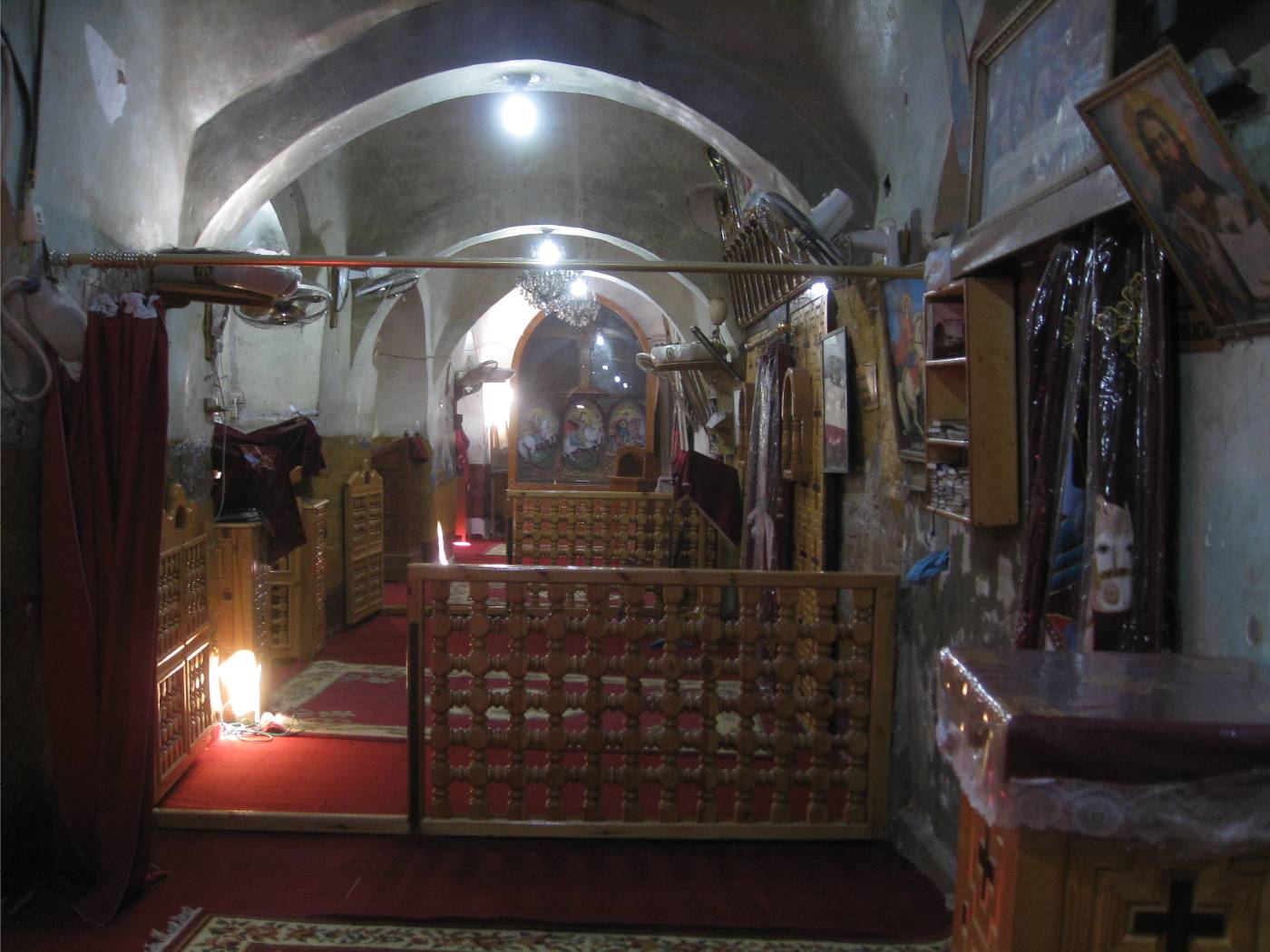
The monastery was dedicated to Saint Tawdros (Theodore), an officer in the Roman army under the Emperor Diocletian. Refusing the emperor's demand to worship Apollo, he was affixed to a tree with 153 nails. Honoured as a saint  in the Orthodox and Catholic churches, the Coptic Church celebrates his martyrdom on the 12th of Toba (the fifth month of the Coptic calendar). At the desert monastery near Luxor, the Saint is worshipped as El Mohareb, The Warrior. Following the iconography of many warrior saints, he appears in full military garb upon his rampant steed.

The original monastery built by St. Helena was demolished in the eleventh century. At some unspecified time later, the Saint appeared in a dream to the local governor and asked that the monastery be rebuilt. By this point in time, the previous monastery's existence had been forgotten so the Saint had to lead the governor to the site. Some of the blocks used to build the sanctuary have been recycled from a pharaonic temple, perhaps from nearby Medinat Habu, thus Coptic crosses were carved over upside down hieroglyphs.

Except for the presence of electricity that powers the water pump and the shrine's lamps, a visit to the monastery of Saint Tawdros feels very ascetic. On this particular Tuesday, we were the only visitors until the arrival of an important church official and six engineers who came to discuss the renewal of the church.

Behind the monastery lies a Coptic cemetery. The dead are clothed entirely in white, including a head scarf, gloves, and stockings. They are carried to the burial in a funeral bier and then lowered into tombs carved into the bedrock. Small entry pits give access to a wider chamber where several bodies are laid side by side. When the tomb is full, the chamber is sealed with bricks or a metal door and the pit is filled in. There are no markers. So very different from the gold tiled tomb and red granite sarcophagus of Empress Helena in Rome and the Vatican Museum.

But most certainly she would be pleased with the peacefulness and sanctity of the place.


WHERE TO FIND ME


View Larger Map
The vastness of the cemetery outside the monastery's walls is seen clearly in the satellite image.

GETTING THERE USEFUL INFO SOURCES
Drive past the West Bank Antiquities ticket office on route to the Valley of the Queens. At the small police checkpoint there is a signed desert track leading to the monastery. The track runs close to the rear wall of Medinat Habu. Reflections in the Nile Blog, Palm Sunday Experience at St. Tawdros Monastery
Slideshow by CopticPower Coptic Monastery near Luxor - Thederos el Mohareb

Al Zaeem: Perhaps Luxor’s Best Koushary

Debate among scholars and Egyptian cooks contests whether or not koushary (pronounced koosh-ah-ree) is Egypt’s “national dish”. Certainly, koushary restaurants feed millions of Egyptians 365 days a year. No exaggeration. Young, old, poor and rich are nourished by this tasty dish that is rich in carbohydrates and proteins.

The most famous koushary restaurant in all of Egypt is Koushary Abou Tarek, in Cairo. Tarek's father is a success story. He began selling his recipe from a wood street cart years ago and now owns a multistoried establishment near Tahrir Square. He has been famous for his koushary for years but now he is revered for it is said that he fed the January 25th Revolution because his was the only restaurant that remained opened during the strife.

Many Egyptian women will make koushary for their families but the combination of rice, pasta, lentils, chickpeas and tomato sauce is time-consuming to prepare. I often see women carrying bags of koushary home for a late evening meal with their families. A local fellow told me I could find the best koushary in Luxor at Al Zaeem Restaurant in the city's center. Interestingly enough, in Arabic "Al Zaeem" means "The Revolutionary". There definitely seems to be a link between koushary and power to the people.

Al Zaeem has two doors. On the right, stairs lead upstairs, where the décor is glass, marble veneered walls and tabletops and stainless steel plates and utensils. Here customers sit and have their favourite meal delivered to their table. Down at street level, from the wide open 'door' on the left, a constant stream of customers flow in and out with take-away orders.

Stacks of small and medium-sized plastic tubs in a storefront window often identifies a koushary restaurant. Behind the stacks stands the koushary's maestro. Some are very entertaining to watch as they twirl their spoons and play a little tune on the pots and dishes. Abou Ahmed at Al Zaeem is more down-to-earth. His focus is on getting the people their food. A conservative estimate puts the numbers of  koushary orders at approximately 20,000 per day.

All ingredients are precooked in the back kitchen and kept warm up front in large open bowls. Do not touch the counter beneath them -- it's hot!

First into the take-away tub is the pasta, a mixture of tubuli and short strands of spaghetti. Next, a big scoop of Egyptian rice is heaped in. Egyptian rice often includes pieces of fried vermicelli. Onto this carbohydrate base goes a good helping of brown lentils coated with seasonings and a ladle of tomato sauce.

Finally, fried onions and chickpeas are sprinkled on top.

Tubs are then sealed and packed with a plastic spoon. Take away orders come with two small plastic bags filled with two important condiments: a spicy chili oil and a tangy garlic vinaigrette.

Upstairs in the seating area, the dish is served with tomato sauce on the side, to be added according to the customer's taste. The size of the condiment vessels stationed at every table conveys the relative proportions of garlic and chili sauces that are typically added. A small pitcher contains the vinaigrette  da’ah made of lemon juice, garlic, cumin, vinegar and water; whereas a tiny bowl holds the hot sauce, called shattah, which is a mixture of hot chili pepper and oil.

Caution should be exercised when applying this Egyptian hot sauce. Its glowing crimson colour only hints at its fiery flavour.

Koushary is a hearty meal. A small portion is generally sufficient to appease a normal appetite. A medium portion feeds two people quite nicely, while the large portion feeds a family. All this tasty nourishment comes for between 2LE (small) and 5LE (large). At today's exchange rates, a family can eat for about 85 cents. If they are Egyptian. Unfortunately, the cashier at Al Zaeem enjoys cheating foreigners by charging them double. The cash receipt states the price quoted but the Arabic text shows that he's charged for a chicken meal not koushary. Such is the frustrating reality of shopping in Luxor.

Regardless of the cashier's tricks, the koushary is delicious and it both nourishes the body and soothes the soul. Centuries ago, the fourteenth century scholar Ibn Battuta wrote about koushary in his travel diaries yet some debaters insist that the dish was not made in Egypt until World War II when British troops brought the recipe from India. Whatever its origin, koushary is definitely ‘the food of the people’.

WHERE TO FIND ME


View Larger Map
The red storefront of Al Zaeem Restaurant is almost visible in the bottom right corner of Google's map. If you zoom out, you will see that it is located very close to Luxor Temple.

GETTING THERE USEFUL INFO SOURCES
Al Zaeem Restaurant is located on Moustafa Kamel Street in downtown Luxor. From the Emilio Hotel, walk approximately 200 m East on Moustafa Kamel Street. The restaurant is on the left-hand side. Its facade cannot be missed. Serious Eats article: “Koshary: Feeding a Revolution in Cairo” by S. Farhan Mustafa
Al Masry Al Youm article: Koshary Confidential
World Vision Report audio news report: "Koshary: The Food that Fed a Revolution"
EgyptianRecipes.Net website: Koshari Recipe
Tour Egypt website: Koshary
Clifford A Wright website: History of Koshary

Medamud: Past-Present Continuum Revealed


A procession of corpulent male deities and busty female deities parade before me. Each one comes to the god’s house bearing gifts from their region. Some bring grain; others cattle, precious metal dishes, libations or incense.


 Glancing over the head of a goddess that herds goats before the god, I spy their modern descendants jumping over the ruins of the god’s house. Past and present become contemporaneous.


It is a quiet morning at the house of Montu, god of war. The only visitors are me, the goats, and a few antiquities guards, called gawfeers in Arabic. Montu has had a temple at Medamud, located about 8km North of Luxor, since the Middle Kingdom. Four millennia have passed and relatively little of the temple remains visible. Correlating the guidebook's plan with bits of walls on the ground poses a challenge. Medamud is in ruin. Perhaps this is why the site is not open for visitation except by request. But step forward. Narrow the eyes’ focus to the preserved details. Exquisite splendor is revealed. It is well worth asking the Karnak inspectorate chief for permission to visit.


Egyptian temples represent a microcosm of the universe. The carving that covers every inch of its surface conveys the sensitivity of the artists to their universe. Ducks flutter above an offering tray. New shoots bend in the breeze. A dado of papyrus buds and blossoms around the temple's inner walls recreates the mound of creation from which all life was born.


And in this universe, men play the harp and women dance with castanets. The countless hieroglyphs record a hymn: “The priest honours You with his basket, And the drummers take their tambourines. Ladies rejoice in Your honor with garlands, And girls do the same with wreaths.”


I conclude my visit with a walk along the Avenue of Sphinxes to the quay. From here Montu, carried by priests, boarded his sacred barque and traveled along the canal to his residence at Karnak. Here, too, worshippers disembarked bearing alms for their falcon-headed lord. I looked down and found graffiti footprints of some nameless ancient. Carved as an act of personal piety to express eternal devotion, the prints match my own. Once again, past and present converge at Medamud.


WHERE TO FIND ME


View Larger Map

GETTING THERE USEFUL INFO SOURCES
Driving out of Luxor on Airport Road, turn North towards Qena. After 5.5 km along the Qena Road, turn West on a small road that crosses the canal and the narrow gauge railway for sugarcane harvest. The village of Nag al-Medamud is just ahead. At the first T-intersection, turn left. At the next T-intersection, turn right. Drive past the goats in the village square and you see the temple of Montu in front of you. Drive along the temple's north side where you will see the gawfeer's hut. Egyptian Monuments blog:
Medamud
Tour Egypt article: The Temple of Montu, Rattawy and Harpocrates at Medamud
Archaeology of Ancient Egypt: Medamud
Musee des Beaux Arts, Lyon: Kiosk Gate from a Temple at Medamud
Luxor News blog: Medamud temple, north of Luxor
Neferuhethert: Hymn from Ptolemaic Temple at Medamud