Showing posts with label Crafts. Show all posts

The Potters of Garagous

A worn sign told us that we had found it. "Here is the Pottery" it said, with the subtext "Congratulations, you found the place!" Venturing off the main byways of Egypt to find something specific, rather than just taking in the view, can be a challenge. Yet finding the potters of Garagous, a village 27 km North of Luxor, was remarkably straightforward.

As we left the main Luxor-Qena highway, we asked directions from a passing motorcyclist. Somewhat surprisingly, he knew exactly what we wanted and how to get there. He gave explicit instructions to our driver -- and repeated them twice. At the next turn, we asked for confirmation from a driver of one of the pick-up trucks that has been remodeled into a public taxi with a cab on the back to seat 10 people. He shouted, "Follow me!" After his route diverged from our own, we were hailed by another service taxi driver who spotted the hawaga (foreigners) and knew what they were looking for. And then, all of a sudden we saw the sign. Hurray!

Since we were visiting on a Friday, there were few people at the pottery center but we were sincerely welcomed and given a tour of the facility. The famous Egyptian architect Hassan Fathy built the complex in 1950 using traditional mud-brick architecture that he was working to re-establish in Egypt. The workshop was very spacious and designed with functional workspaces for each task.

Hasan Fathy used domes and vaults for ventilation and natural cooling. Under his lantern domes (shukshaykas) at Garagous, the craftsmen work in a cool atmosphere, made all the cooler by the use of water evaporating in a trough in a narrow space between two walls that was open at ground level. The air flowed naturally from outside down the windcatcher (malkhaf), across the water and into the room creating a low-tech 'swamp cooler'.

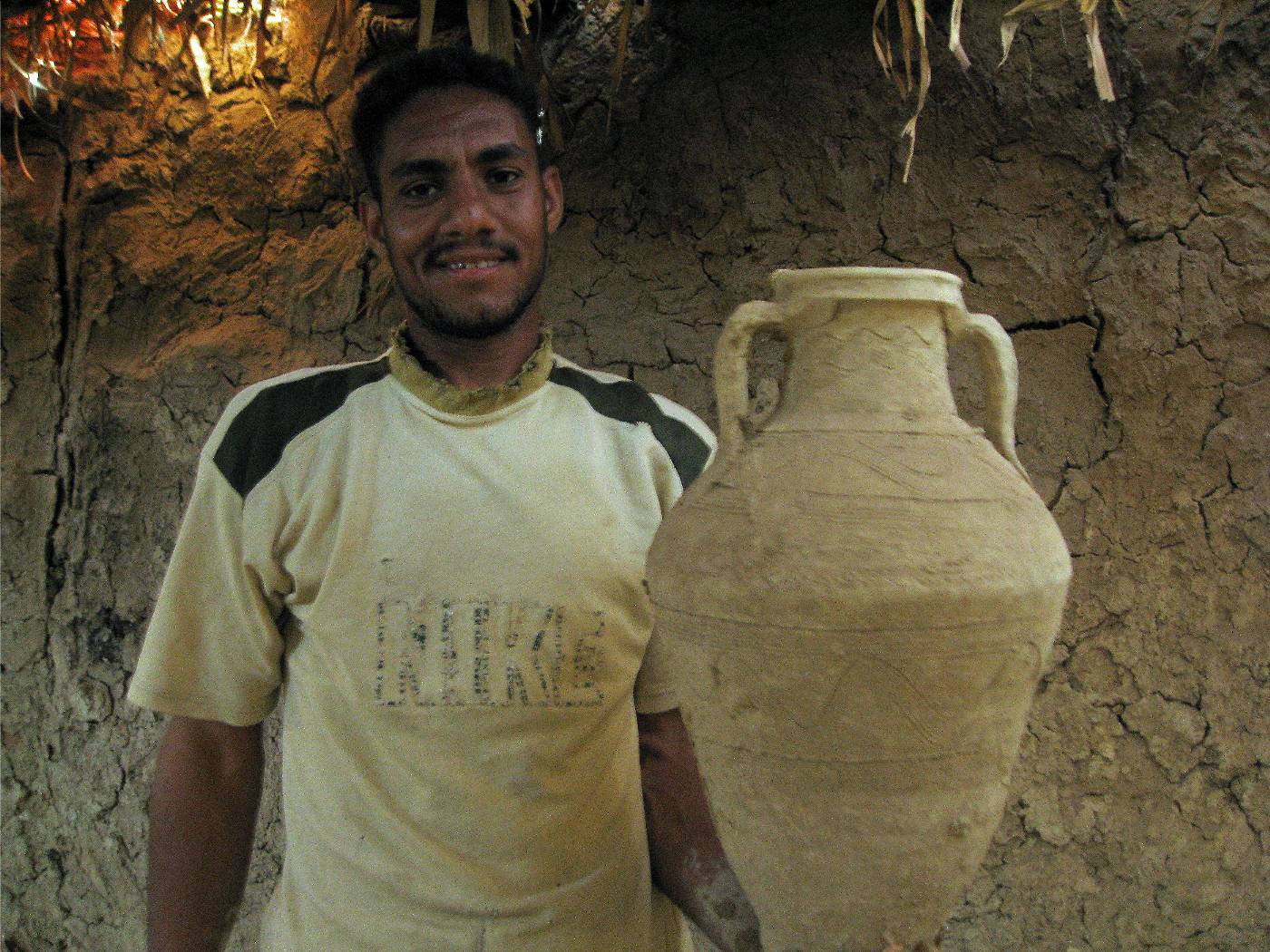
Girgus, the master potter, says he can throw about 200 pots a day. He follows the techniques first taught in Garagous in 1955 when two Jesuit monks from France established the centre with the assistance of a nephew, Robert De Mongolfier, who owned a pottery factory in France. Their efforts to create sustainable employment has transformed the impoverished village, where it is estimated that half the population now works in the community-based ceramic industry.

In another zone, plates and casserole dishes are made using plaster moulds. Plates are probably the centre's most popular product decorated with birds and fish.

In the open-air courtyard the clay is prepared for the potters. The clay used in Garagous pottery comes from Abu Simbel. The raw clay arrives at the centre where it is mixed with water and then purified as the mixture passes through three screens of progressively finer mesh into a drying basin. The resulting clay is beautifully smooth and malleable.

The distinct colours of Garagous pottery are green and blue.

St. Mary protects the original kiln in the courtyard while an adjacent building is home to two new electric kilns that are filled to capacity.

The beautiful result of all the work is piled on shelves in the storage room. This is a treasure trove for pottery enthusiasts with stacks of plates, bowls, mugs, casseroles, jugs, and teapots. Airline restrictions on baggage weight necessitates some hard decision-making to select just a few pieces, but oh what fun!

The repertoire of Garagous potters extends beyond plates and bowls. The products for sale in the display room reveal creativity and a sense of humour. These traits are embodied in a comical rendition of the Sphinx. Its bright yellow mane encircles an Egyptian portrait. It would be interesting to know who the model is because there is probably a story hidden behind the sphinx's enigmatic smile. Perhaps he smiles because he knows where to find Garagous pottery.


WHERE TO FIND ME


View Larger Map
Trying to find the Centre on Google Maps has posed the most difficult challenge to date. I must admit that I have doubts that I have truly identified the correct building. When I return to Garagous, perhaps in the distant future, I will check my bearings.

GETTING THERE USEFUL INFO SOURCES
From the Luxor airport checkpoint, drive North on the Luxor-Qena highway for 20.6 km and turn left (West) off the highway, crossing over the big irrigation canal.

After crossing over the railway tracks and 0.4 km from the main highway, turn right (North) and follow the asphalt road that runs beside a small irrigation canal. Heading North, the canal will be on your right and a narrow-gauge sugarcane rail line will be on your left.

After 4.3 km, you will come to the first bridge over the canal and see a sluice gate on the right. You'll probably also see a gamoosa (water buffalo) tethered to the side of the road. Turn left (West) at the gamoosa. ;-)

Travel for 0.8 km and make another left turn. This road leads you through town and past a very tall, see-through minaret constructed of iron grillwork -- an Eiffel Tower, of sorts -- in the centre of Garagous. At 0.7 km from the previous turn, there is a dirt road on the right. Turn right and drive 0.3km on this dirt road, past a domed mausoleum for a local sheikh. Turn left and the center is immediately on your left. Look for the sign: "Here is the Pottery". You'll know you have reached the right place.
Hassan Fathy PDF document: The Man and His Legacy and Catalogue of Works of Hassan Fathy by Ismail Serageldin
Garagos Handmade Company website: A History and Catalogue of Garagos Pottery
Al Ahram Online news article: Folk Arts: Garagos Pottery in Town
Potter Girgus Youssef contact number: 012-950-2471

Hagaza and its Famous Woodworkers

An uneasy expression had developed on my driver's face. Without words Adel expressed his worry that we would fail in our mission to find the woodworkers in what he considered an obscure village. My declaration that the village and its woodworkers are famous did not reassure him. Apparently, their fame does not extend beyond Cairo.

To ease Adel's concern, we telephoned a number that I had found on the Internet. Good fortune put us in contact with a carpenter named Ashraf, who met us somewhere in the sprawl of Hagaza village, located some 25 km North of Luxor. Its intricate network of dirt roads is lined with the homes of 60,000 people.

Ashraf took us to his two-room home. Here, in the back room with the family kitchen, he stains products made in the workshop that I was seeking. A computer with a database of product images has pride of place in the 2 m X 1.5 m front room. Wide benches on either side of this room serve multiple purposes: sofas for guests, beds for sleeping, and product display for surprise visitors.

Egyptian hospitality necessitates a glass of tea, which I sip while discussing all the products available for purchase. Ashraf brings out from the back room a beautiful slated-back arm chair that he has stained. Regretfully, LE500 is more money than I have to spend on this trip. When I ask the price of a wooden salad bowl, he pulls out a measuring tape to determine the size of the block of wood it was carved from.

With purchases in hand, Ashraf guides us the 3 km length of the village to our goal, the Hagaza Woodwork Vocational Training Center. Success!

For some 25 years, the center has been training the unemployed young men of the village in woodworking skills in order to alleviate poverty. Ashraf graduated from the program 15 years ago and has been able to provide for his family ever since. Life isn't easy but, thanks to his training and product marketing conducted in Cairo, it isn't dire.

Fifteen young men each year enroll in the three-year training program operated by an Egyptian non-governmental agency called the Association of Upper Egypt for Education and Development. None of the students were in attendance on this particular Tuesday because the national government closed all schools when the revolution began and has yet to re-open all of the universities and trade schools South of Cairo out of "security concerns".

Another unfortunate consequence of recent political developments was the cancellation of the annual exhibition in Cairo where many of Hegaza's small wood-carved objects are sold. It is the sales at this exhibition and through the Fair Trade Egypt shop that the craftsmen depend for their livelihood. And it is through these marketing efforts that Hagaza woodwork has become well-known, if not famous.

Hagaza's exhibition room presents a wide variety of products for sale. Pharaonic designs inspire many of the products, particularly the elegant nut trays that recall stone make-up tablets on display in the Louvre and Cairo's Egyptian Museum. But individual artistic imaginations obviously have scope here too as I spy a couple of Hagaza Godzillas on the top shelf.

Each nut tray represents about six hours of work, while a sculpted panther takes about two days. Mostly, the men carve wood from the "Sersau" (Dalbergia sissoo) tree, which the Centre brings from Aswan. Generations ago, the British imported the tree from India and it seems to flourish in southern Egypt, which is surprising given the climatic differences. Local tamaris (Tamarix aphylla), a blond wood, and Nile acacia (Acacia nilotica) are other popular woods that are carved.

From these woods the men trained at the Centre are carving out a better life for themselves and their families. Many, like Ashraf, now work independently. The Hagaza Centre shows how a relatively small investment made to increase human skills and to create links to external markets makes a big difference to people living in little corners of the world, and maybe even makes them famous.


WHERE TO FIND ME


View Larger Map
This building, located on the edge of the desert, houses the woodworking training facility.

GETTING THERE USEFUL INFO SOURCES
Because the Hagaza Woodwork Vocational Training Centre is located at the south end of the village of Hagaza, it is easiest to approach it from the village of Khuzam to the South.
Beginning from the Luxor Airport checkpoint, drive North on the Luxor-Qena highway for 16.8 km. You will pass a major checkpoint at Ashi. The next major checkpoint is located at the village of Khusam. Immediately after passing through the maze of road barriers, turn right (East) and follow this road for 4.3 km. You will drive beside an irrigation canal rich with bird life.
Now the route gets tricky. After 4.3km, turn right (East) on a narrow road. Follow this road and turn left (North) at the first intersection. Travel North for about 1 km and turn right (East), heading out into the desert. You will see the high walls of the Centre on the right.
Association of Upper Egypt for Education and Development website: Hagaza Vocational Training Centre
Fair Trade Egypt website: Hegaza Wooden Craft Project and Product Sales
Ashraf of Hagaza contact number: 012-140-6920

Deir El Ballas: Mother of Pots

Egypt is comprised of two disparate lands: the verdant Nile valley and the parched desert plateaus that border each side. The stark contrast is striking whether viewed with feet firmly planted on the ground or floating in space, and it is even embodied in bits of broken pots unearthed in archaeological excavations.

Nile silt clay produces pottery that is red in colour, while desert marl clay results in whitish wares. The difference lies in their makeup. Silt, carried vast distances from upstream and deposited here when the floods ebbed, is rich in iron oxides. Marl clay, on the other hand, is concentrated with calcium carbonates that come from adjacent limestone deposits. Even their characters are different. Nile clay is malleable, while desert marl is hard and more difficult to work.

But Egyptians have worked with this rock-like clay since predynastic times, about 4,000 B.C., particularly in the area near the modern city of Qena. Driving North from Luxor along the new desert highway the entire landscape is pinky grey and the high desert plateau forms a formidable bastion all along the east side. The landscape is daunting; one may even think it threatening. Yet following the desert wadis, or dry riverbeds, men enter this bleak realm to mine clay which is then transported by camels and donkeys down to a village at the desert's edge. Here the clay is broken up into smaller pieces and soaked in a round basin beside the potter's workshop.

The village is home to twenty families, each with a small workshop. A father, two sons and a cousin produce more than one hundred pots and garden water pipes each day. The work is hard and seemingly non-stop, even when a strange foreign visitor arrives on their doorstep.


The video captures some of the activity inside the 4 X 5 meter room, with most of the space dedicated to the preparation of the clay. Two men knead the clay with their feet to remove pockets of air. They also remove any 'impurities', such as pieces of calcite, that might damage the final product and add some fine sand to temper the clay.

Meanwhile, the potter works on his kick-wheel to complete the rounded bases for the jars. This is the final stage. The handles have already been added. He adds a length of twine around the jar's widest point near its base to hold its form while it dries. Twine markings are visible on sherds of ancient jars, so this potter works within a long tradition.

Lastly, with a chip of wood or a bit of a tree branch the potter might add a little decoration, a wavy line perhaps to the shoulder. Then his father takes the jar away for final drying before firing it in the kiln. Note that the walls of the workshop have been built of pots. Cuts made in some of the pots provide useful storage spaces. This same construction is used for animal pens and dovecotes.

Outside the door, kilns resemble hollow towers built of brick into a small hill. They are stoked from a small arched opening at ground level. Inside, just above the level of the door, is a grated floor that suspends the pots above the fire and allows the heat to pass upwards through multiple layers of neatly piled pots. The pots are loaded into the kiln from the top and then covered with a layer of straw. The fire is fueled for four hours with straw or sugarcane stalks that have been pressed for their juice, called bagasse. After the initial heating, the pots continue to 'cook' for a day from the radiant heat in the kiln and in the pots themselves.

Thus the ballas is created. All share the same amphora shape but are available in various sizes. The smaller ones are used to hold molasses or to age village cheese. Medium-sized ballaliis hold fresh milk as it separates its cream. Large ballaliis are used to carry water.

Making pots is tough work and life on the edge of the desert is hard - as hard as the marl clay they work. A visit to the potters at Deir el Ballas is fascinating, enjoyable and educational, but I return to the green valley with a sigh of relief. Life under palm trees feels far less vulnerable.


WHERE TO FIND ME


View Larger Map
It is amazing that an image taken from 681 kilometers (423 miles) above the Earth's surface enables us to see the round kilns, the bundles of bagasse that fuel those kilns, the grey mounds of raw clay, and the hut in which clay is transformed by the potter. The large supply of unprocessed clay suggests that the satellite image was taken late in the year at the end of the mining season. Clay is not mined during damp winter months because it becomes soft and can cave in on the miners who do not use roofing supports in their work.

GETTING THERE USEFUL INFO SOURCES
Drive North from the main West Bank checkpoint to the sign indicating a left turn to Sheikh Tayb Saha village. Follow this road out to the desert Luxor-Qena highway. Some 48 km from the turn, watch for rolls of bagasse on the east side of the road. This is the home of the Deir el Ballas potters. "Village" seems to denote a habitation much larger than theirs. UCLA Encyclopedia of Egyptology article: Pottery Production by Paul T. Nicholson
Tour Egypt article: The Pottery of Ancient Egypt by Mark Andrews