Creation and Elimination at Esna

Divine forces create humans while human forces eliminate them -- so might be the lesson enshrined in the Temple of Khnum at Esna, 55 km South of Luxor. Carved into the temple's sandstone walls is the ancient Egyptian belief that ram-headed Khnum created the world and crafted humans out of Nile mud on his potters' wheel. He shaped the individual features and languages of Egyptians and foreigners.

Carvings tell that Khnum plants the seed of life in every mother's womb, depicted as a zigzagged oval perhaps to illustrate its life force. Simultaneously, Khnum also forms the 'ka', or spirit, of the child. Nine months later, he and Heket, the goddess of childbirth, help the mother at the child's birth as she sits on the birthing chair. The Great Hymn to Khnum (M. Lichtheim, Ancient Egyptian Literature, Vol. 3, p. 112) praises his effect:
He makes women give birth when the womb is ready,
So as to open --- as he wishes;
He soothes suffering by his will,
Relieves throats, lets everyone breathe,
To give life to the young in the womb.

The temple at Esna is dedicated to Khnum, his consort Menheyet, and his son Heka ('Magic'). The goddess Neith is also honoured here because she is the feminine force of creation and works in partnership with Khnum's maleness. While Khnum created the world and separated heaven and earth, Neith uttered seven sentences to give form to and organize creation.

As Khnum's temple at Esna celebrates the creation of life its walls also bear witness to the snuffing out of human life at the hands of less than godly men.

The Roman emperor Septimius Severus ruled the Roman empire from 193 to 211 A.D. He appears on Esna's walls with his sons Caracalla and Geta, who ruled jointly with him in the final years of his reign, 209-211. One might surmise that the reliefs were carved during this time.

Soon after the death of their father, Caracalla murdered Geta. Across the empire, from Rome to Esna and beyond, the murderer ordered that all mention of his brother to be erased from monuments in an act of damnatio memoriae. Thus, late in 211 or early 212, carvers returned to Esna to chip away the existence of Geta. Yet his shadow and the shadow of his name in hieroglyphs remains evident on the wall and so he is not forgotten.

Building temples could take centuries to complete as successive pharaohs renovated and enlarged important holy sites. When the Romans took control of Egypt, the emperors continued the tradition of the pharaohs and similarly made their alms to the Egyptian gods with temple building and decoration. Much of what can be seen today at Esna is the work of Roman emperors from Claudius (41-54 AD) to Decius (249-251 AD). One of the unique images decorating the temple is that of the Roman emperor Trajan, as pharaoh, dancing before the enthroned goddess. The lion-headed goddess looks a lot like Sekmet but she is Menheyet, Khnum's consort.

An image not found in any pharaonic period temple is that of the emperor presenting a victory wreath to the god. The Roman emperor would have considered this the highest tribute he could offer.

The temple is famous for its astronomical ceiling. The constellations, as the Egyptians knew them, sail across the sky in boats just as boats were the main form of transportation for earthly beings.

The ceiling is intact, supported by 24 columns. Each column capital is unique and colourful. The carving is intricate and awesome to behold. Every inch of the column shafts are also carved with hieroglyphic texts that provide the program of religious festivals conducted in the temple -- perhaps so that the festivals continue in perpetuity through the magic of the sacred texts.

This column represents a date tree. The base of the capital recreates the palm's knobby trunk. Sprouting upwards from the column/trunk is the broad capital carved with palm fronds and heavy fruit clusters. As if to emphasize the fecundity of creation, grape vines also prosper amidst the fronds.

Even the standard images that one expects to see on an Egyptian temple have a slightly different character at Esna. The scene of the pharaoh smiting Egypt's enemies is seen over and over again on temple walls as each king showed off to his people that he was an effective defender of the realm. The common motif depicts the pharaoh holding in one hand the chiefs of enemy states by their hair, while raising his club high above his head in the other hand. Esna's depiction of Ptolemy III Euergetes is unique with the presence of a pet lion that appears to eat the hands of the captured.

Less than one-third of the temple is visible today. In the mid 19th century the French Egyptologist, Auguste Mariette, removed buildings and excavated a 9-metre deep pit to reveal the temple's hypostyle hall. Egypt's Ministry of Antiquities hopes to conduct excavations to clear the debris and reveal the interior rooms of the god's house. No doubt, their excavations will produce exciting finds and understanding of the earlier pharaonic worship of the god of creation.


WHERE TO FIND ME


View Larger Map
The shadows give an impression of the 9m (30')-deep pit in which the temple currently resides. There is a plan to extend the pit all the way to the Nile river to reveal the ancient causeway and provide access to the temple for tourists arriving on the cruise boats. An historically significant mosque, however, is situated along the proposed route so this plan requires some serious thought.

GETTING THERE USEFUL INFO SOURCES
Esna is an easy half-day trip from Luxor. We drove South on the west side of the Nile and returned to Luxor on the eastern highway. The western road is slower due to a number of villages, but it is an interesting route for that very reason.

The temple is located less than kilometer south of the Esna barrage. It cannot be seen from the Corniche. Look for the small wooden kiosk that sells entry tickets on the east side of the road. Park the car nearby and walk a short distance through the souk to the temple. 
Egyptian Monuments blog:
Esna Temple
Tour Egypt article: The Temple of Khnum at Esna by Mark Andrews
The Great Hymn to Khnum: Ancient Egyptian Literature translated by Miriam Lichtheim
Ancient Egypt Online article: Esna Temple

An Empress and a Saint in the Desert

A widow well in her seventies travelled through the mountains and deserts of the Middle East looking for relics of her faith. Her discoveries led to her being chosen as the patron saint of archaeologists. This intrepid traveller, famed for finding pieces of the True Cross, was Flavia Iulia Helena Augusta, the mother of Emperor Constantine. With unlimited access to the Roman treasury, she built the Church of the Nativity in Bethlehem, the Church on the Mount of Olives, the Church on Mount Sinai and, it is said, the first monastery in the desert near the Valley of the Queens.

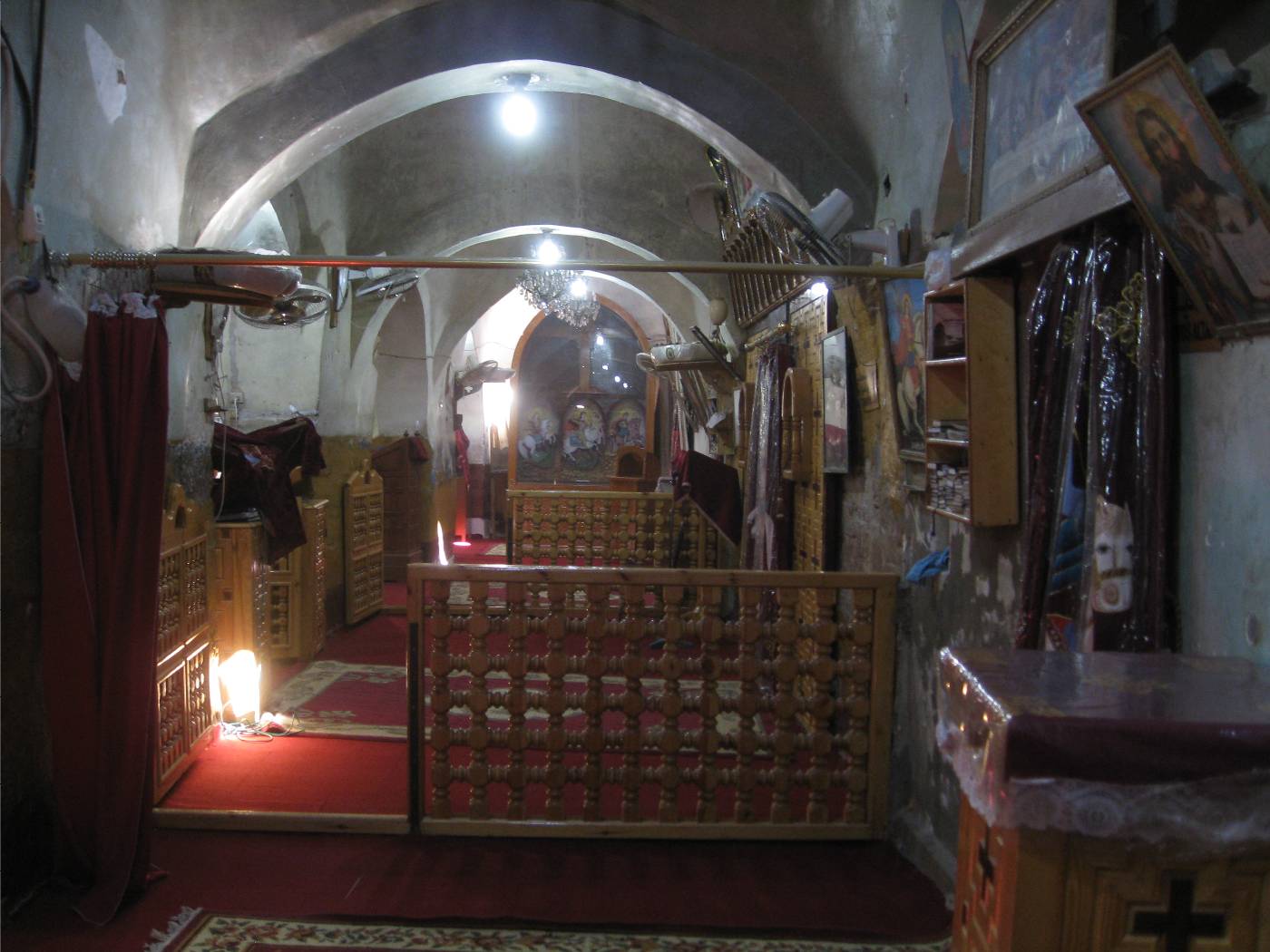
The monastery was dedicated to Saint Tawdros (Theodore), an officer in the Roman army under the Emperor Diocletian. Refusing the emperor's demand to worship Apollo, he was affixed to a tree with 153 nails. Honoured as a saint  in the Orthodox and Catholic churches, the Coptic Church celebrates his martyrdom on the 12th of Toba (the fifth month of the Coptic calendar). At the desert monastery near Luxor, the Saint is worshipped as El Mohareb, The Warrior. Following the iconography of many warrior saints, he appears in full military garb upon his rampant steed.

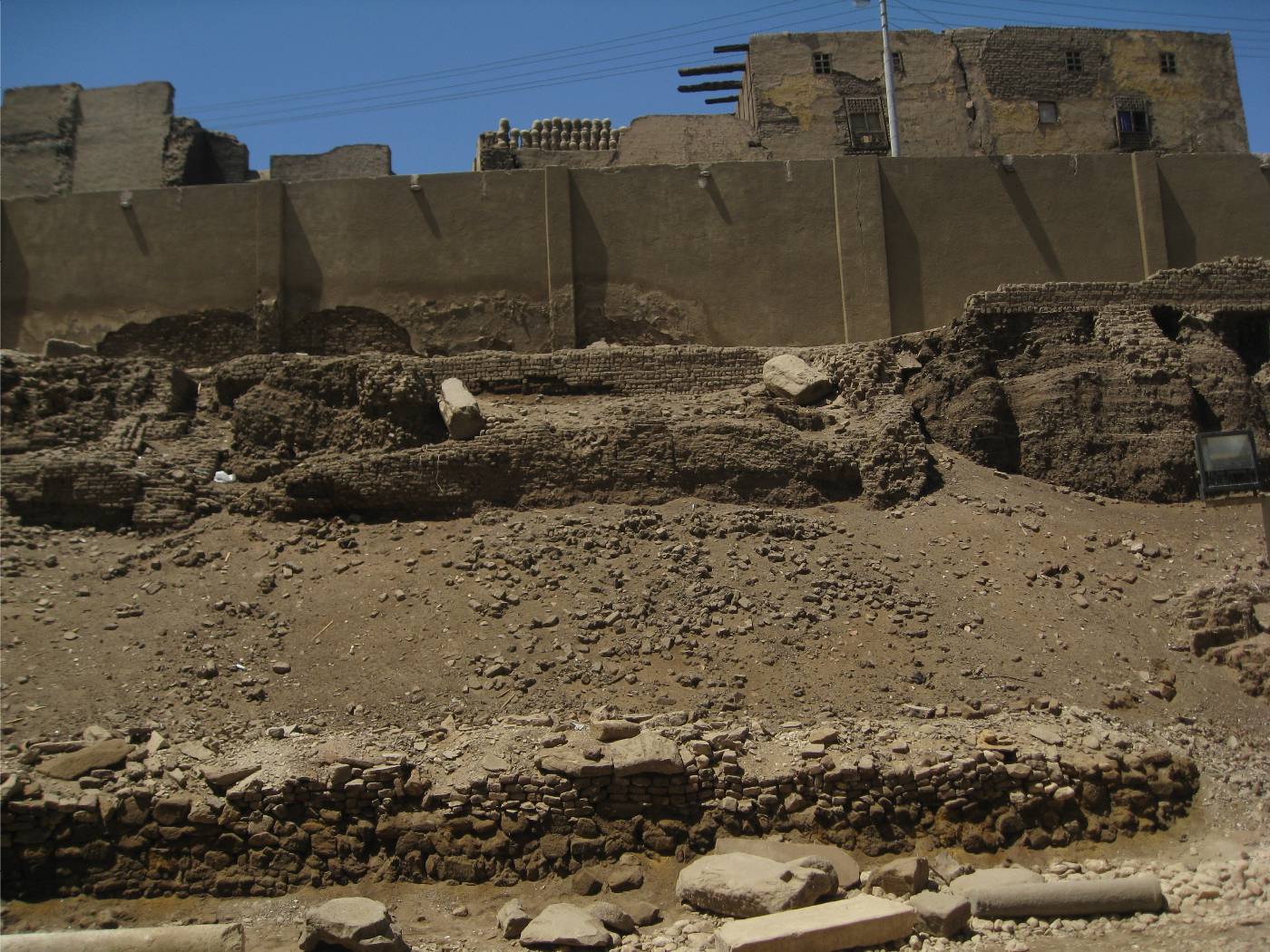
The original monastery built by St. Helena was demolished in the eleventh century. At some unspecified time later, the Saint appeared in a dream to the local governor and asked that the monastery be rebuilt. By this point in time, the previous monastery's existence had been forgotten so the Saint had to lead the governor to the site. Some of the blocks used to build the sanctuary have been recycled from a pharaonic temple, perhaps from nearby Medinat Habu, thus Coptic crosses were carved over upside down hieroglyphs.

Except for the presence of electricity that powers the water pump and the shrine's lamps, a visit to the monastery of Saint Tawdros feels very ascetic. On this particular Tuesday, we were the only visitors until the arrival of an important church official and six engineers who came to discuss the renewal of the church.

Behind the monastery lies a Coptic cemetery. The dead are clothed entirely in white, including a head scarf, gloves, and stockings. They are carried to the burial in a funeral bier and then lowered into tombs carved into the bedrock. Small entry pits give access to a wider chamber where several bodies are laid side by side. When the tomb is full, the chamber is sealed with bricks or a metal door and the pit is filled in. There are no markers. So very different from the gold tiled tomb and red granite sarcophagus of Empress Helena in Rome and the Vatican Museum.

But most certainly she would be pleased with the peacefulness and sanctity of the place.


WHERE TO FIND ME


View Larger Map
The vastness of the cemetery outside the monastery's walls is seen clearly in the satellite image.

GETTING THERE USEFUL INFO SOURCES
Drive past the West Bank Antiquities ticket office on route to the Valley of the Queens. At the small police checkpoint there is a signed desert track leading to the monastery. The track runs close to the rear wall of Medinat Habu. Reflections in the Nile Blog, Palm Sunday Experience at St. Tawdros Monastery
Slideshow by CopticPower Coptic Monastery near Luxor - Thederos el Mohareb

Qus: A Town of Distinction

Tuesday morning streets in Qus teem with pedestrians, carts and vehicles. It's market day and the street melange might strike the visitor as rather chaotic but no one else seems to notice. This is their daily life. There are goods to be bought and sold, prices to be argued, news to be exchanged, politics to be discussed and chickens to be butchered. All of this takes place to the somewhat discordant chorus of car horns in the narrow streets of this medieval city.

In fact, the scene today is probably not too dissimilar from the tenth century when this town rose to prominence as Egypt's second most important city, after Cairo. And it remained key for six hundred years thanks to its pivotal location on the trade route between East and West. All goods from India and Arabia that passed through Qus on their way to Mediterranean markets until 1498 when Vasco de Gama discovered an alternative sea-route around Africa.


That trade brought Qus much prominence and wealth, which explains why in this backwater town of modern times you will find the most important medieval monument in Upper Egypt. Al Amri Mosque was founded in 1083 and many sultans and pashas added to its splendor over the centuries.

The mosque has an open enclosure plan featuring arcades of columns surrounding a large opening in the roof to fill the building with light and air. Surprisingly, the cacophony from the street seems to stay outside the walls.

The original builders reused columns and capitals from some unknown Roman monument built by some distinguished official in a town that commanded an important position in the transfer of granite and marble to the imperial courts in Rome and Byzantium. Under the arcade, or riwaq, Moslems gather to hear the imam's sermon and to pray.

The riwaq and the qibla wall are the only surviving elements of the original Fatimid mosque. The arched mihrab indicates for Moslems the direction of the Kaaba in Mecca so that they can orient themselves correctly for their daily prayers.

The mihrab's interior is decorated with magnificently intricate stucco work that dates to the Mamluk period (1250–1517). The Quranic inscription that frames the arabesque design in the centre is written in Thuluth script. This style of calligraphy was revolutionary in the eleventh century because it replaced the straight block letters of Kufic script. Thuluth's letters flow in a cursive style because one third of each letter is curved.

The imam reads the weekly sermon from a stepped platform, called a minbar. Al Azmi's minbar is of intricately carved wood and is one of the oldest in Egypt. The Fatimid vizier al-Salih al-Tala'i presented this magnificent podium to the mosque in 1155 when he governed Qus. He later went on to build his famous mosque in Cairo. The Quranic inscription that graces the lintel over the platform's entrance is written in the block-like Kufic script. The seemingly incongruous microphone at the top of the stairs shows that the minbar remains integral to the mosque's current use.

Every inch of the minbar's teak exterior is intricately carved in complex geometric and vegetal patterns. Islam's prohibition of idolatry forbids the creation of images of God, the Prophet Mohamed and other living beings, giving rise to amazing non-figural art to decorate their houses of worship.

The riwaq, mihrab and minbar are all spectacular but scholars of Islamic architecture distinguish al-Azmi Mosque as the most important medieval monument in Upper Egypt because of the architecture of the dome over the tomb of Mubarak bin Maqlid. Built in 1172, the architect devised an elaborate system of squinches to make the transition between the four-sided room and its domed roof. The dome's six-pointed stars with tear-shaped openings above are quite unique.

Al-Azmi Mosque provides a peaceful place for contemplation of the divine. Across the square is a reminder that secular economic activities enabled the creation of that peace. Quite distinct from the quiet of the mosque is the hustle and bustle of the wakala. Protected behind its strong door, traders stored their goods and housed their animals on the lower level and rented rooms above.

Its exterior brick and woodwork are well maintained. Inside, the balconies are shaky and rooms lack roofs but the building continues to be part of the city's economic life as it is home of a metalworking shop. Although Qus has declined from its high point as Egypt's second city, it remains economically vibrant and a town of distinction. Well worth a visit!


WHERE TO FIND ME


View Larger Map
The large roof with an opening to the sky distinguishes Al Azmi Mosque amid the complicated matrix of other buildings in the center of Qus.

GETTING THERE USEFUL INFO SOURCES
Drive North on the Luxor-Qena highway. Approximately 30 km from Luxor turn East at the well-marked turn-off for Qus. This road becomes Al Nasr street. Some 3.4 km from the highway, turn left. It is almost a straight shot to reach al-Azmi Mosque but it is best to begin asking directions once you turn off Al Nasr street.

I was told that a entry ticket is usually sold to visitors, however none were available on the day that I visited. In lieu of a ticket, a tip to the man who guards the shoes at the door and LE 20 to the unofficial guide was happily accepted. Simply ask to take a peak inside the wakala. Access to the upper floors is not advisable, but it's worth a look.
Pergamon Museum, Berlin, has a 12th century wood panel from al-Azmi Mosque: Collection of the Museum of Islamic Art

Al Zaeem: Perhaps Luxor’s Best Koushary

Debate among scholars and Egyptian cooks contests whether or not koushary (pronounced koosh-ah-ree) is Egypt’s “national dish”. Certainly, koushary restaurants feed millions of Egyptians 365 days a year. No exaggeration. Young, old, poor and rich are nourished by this tasty dish that is rich in carbohydrates and proteins.

The most famous koushary restaurant in all of Egypt is Koushary Abou Tarek, in Cairo. Tarek's father is a success story. He began selling his recipe from a wood street cart years ago and now owns a multistoried establishment near Tahrir Square. He has been famous for his koushary for years but now he is revered for it is said that he fed the January 25th Revolution because his was the only restaurant that remained opened during the strife.

Many Egyptian women will make koushary for their families but the combination of rice, pasta, lentils, chickpeas and tomato sauce is time-consuming to prepare. I often see women carrying bags of koushary home for a late evening meal with their families. A local fellow told me I could find the best koushary in Luxor at Al Zaeem Restaurant in the city's center. Interestingly enough, in Arabic "Al Zaeem" means "The Revolutionary". There definitely seems to be a link between koushary and power to the people.

Al Zaeem has two doors. On the right, stairs lead upstairs, where the décor is glass, marble veneered walls and tabletops and stainless steel plates and utensils. Here customers sit and have their favourite meal delivered to their table. Down at street level, from the wide open 'door' on the left, a constant stream of customers flow in and out with take-away orders.

Stacks of small and medium-sized plastic tubs in a storefront window often identifies a koushary restaurant. Behind the stacks stands the koushary's maestro. Some are very entertaining to watch as they twirl their spoons and play a little tune on the pots and dishes. Abou Ahmed at Al Zaeem is more down-to-earth. His focus is on getting the people their food. A conservative estimate puts the numbers of  koushary orders at approximately 20,000 per day.

All ingredients are precooked in the back kitchen and kept warm up front in large open bowls. Do not touch the counter beneath them -- it's hot!

First into the take-away tub is the pasta, a mixture of tubuli and short strands of spaghetti. Next, a big scoop of Egyptian rice is heaped in. Egyptian rice often includes pieces of fried vermicelli. Onto this carbohydrate base goes a good helping of brown lentils coated with seasonings and a ladle of tomato sauce.

Finally, fried onions and chickpeas are sprinkled on top.

Tubs are then sealed and packed with a plastic spoon. Take away orders come with two small plastic bags filled with two important condiments: a spicy chili oil and a tangy garlic vinaigrette.

Upstairs in the seating area, the dish is served with tomato sauce on the side, to be added according to the customer's taste. The size of the condiment vessels stationed at every table conveys the relative proportions of garlic and chili sauces that are typically added. A small pitcher contains the vinaigrette  da’ah made of lemon juice, garlic, cumin, vinegar and water; whereas a tiny bowl holds the hot sauce, called shattah, which is a mixture of hot chili pepper and oil.

Caution should be exercised when applying this Egyptian hot sauce. Its glowing crimson colour only hints at its fiery flavour.

Koushary is a hearty meal. A small portion is generally sufficient to appease a normal appetite. A medium portion feeds two people quite nicely, while the large portion feeds a family. All this tasty nourishment comes for between 2LE (small) and 5LE (large). At today's exchange rates, a family can eat for about 85 cents. If they are Egyptian. Unfortunately, the cashier at Al Zaeem enjoys cheating foreigners by charging them double. The cash receipt states the price quoted but the Arabic text shows that he's charged for a chicken meal not koushary. Such is the frustrating reality of shopping in Luxor.

Regardless of the cashier's tricks, the koushary is delicious and it both nourishes the body and soothes the soul. Centuries ago, the fourteenth century scholar Ibn Battuta wrote about koushary in his travel diaries yet some debaters insist that the dish was not made in Egypt until World War II when British troops brought the recipe from India. Whatever its origin, koushary is definitely ‘the food of the people’.

WHERE TO FIND ME


View Larger Map
The red storefront of Al Zaeem Restaurant is almost visible in the bottom right corner of Google's map. If you zoom out, you will see that it is located very close to Luxor Temple.

GETTING THERE USEFUL INFO SOURCES
Al Zaeem Restaurant is located on Moustafa Kamel Street in downtown Luxor. From the Emilio Hotel, walk approximately 200 m East on Moustafa Kamel Street. The restaurant is on the left-hand side. Its facade cannot be missed. Serious Eats article: “Koshary: Feeding a Revolution in Cairo” by S. Farhan Mustafa
Al Masry Al Youm article: Koshary Confidential
World Vision Report audio news report: "Koshary: The Food that Fed a Revolution"
EgyptianRecipes.Net website: Koshari Recipe
Tour Egypt website: Koshary
Clifford A Wright website: History of Koshary

Hagaza and its Famous Woodworkers

An uneasy expression had developed on my driver's face. Without words Adel expressed his worry that we would fail in our mission to find the woodworkers in what he considered an obscure village. My declaration that the village and its woodworkers are famous did not reassure him. Apparently, their fame does not extend beyond Cairo.

To ease Adel's concern, we telephoned a number that I had found on the Internet. Good fortune put us in contact with a carpenter named Ashraf, who met us somewhere in the sprawl of Hagaza village, located some 25 km North of Luxor. Its intricate network of dirt roads is lined with the homes of 60,000 people.

Ashraf took us to his two-room home. Here, in the back room with the family kitchen, he stains products made in the workshop that I was seeking. A computer with a database of product images has pride of place in the 2 m X 1.5 m front room. Wide benches on either side of this room serve multiple purposes: sofas for guests, beds for sleeping, and product display for surprise visitors.

Egyptian hospitality necessitates a glass of tea, which I sip while discussing all the products available for purchase. Ashraf brings out from the back room a beautiful slated-back arm chair that he has stained. Regretfully, LE500 is more money than I have to spend on this trip. When I ask the price of a wooden salad bowl, he pulls out a measuring tape to determine the size of the block of wood it was carved from.

With purchases in hand, Ashraf guides us the 3 km length of the village to our goal, the Hagaza Woodwork Vocational Training Center. Success!

For some 25 years, the center has been training the unemployed young men of the village in woodworking skills in order to alleviate poverty. Ashraf graduated from the program 15 years ago and has been able to provide for his family ever since. Life isn't easy but, thanks to his training and product marketing conducted in Cairo, it isn't dire.

Fifteen young men each year enroll in the three-year training program operated by an Egyptian non-governmental agency called the Association of Upper Egypt for Education and Development. None of the students were in attendance on this particular Tuesday because the national government closed all schools when the revolution began and has yet to re-open all of the universities and trade schools South of Cairo out of "security concerns".

Another unfortunate consequence of recent political developments was the cancellation of the annual exhibition in Cairo where many of Hegaza's small wood-carved objects are sold. It is the sales at this exhibition and through the Fair Trade Egypt shop that the craftsmen depend for their livelihood. And it is through these marketing efforts that Hagaza woodwork has become well-known, if not famous.

Hagaza's exhibition room presents a wide variety of products for sale. Pharaonic designs inspire many of the products, particularly the elegant nut trays that recall stone make-up tablets on display in the Louvre and Cairo's Egyptian Museum. But individual artistic imaginations obviously have scope here too as I spy a couple of Hagaza Godzillas on the top shelf.

Each nut tray represents about six hours of work, while a sculpted panther takes about two days. Mostly, the men carve wood from the "Sersau" (Dalbergia sissoo) tree, which the Centre brings from Aswan. Generations ago, the British imported the tree from India and it seems to flourish in southern Egypt, which is surprising given the climatic differences. Local tamaris (Tamarix aphylla), a blond wood, and Nile acacia (Acacia nilotica) are other popular woods that are carved.

From these woods the men trained at the Centre are carving out a better life for themselves and their families. Many, like Ashraf, now work independently. The Hagaza Centre shows how a relatively small investment made to increase human skills and to create links to external markets makes a big difference to people living in little corners of the world, and maybe even makes them famous.


WHERE TO FIND ME


View Larger Map
This building, located on the edge of the desert, houses the woodworking training facility.

GETTING THERE USEFUL INFO SOURCES
Because the Hagaza Woodwork Vocational Training Centre is located at the south end of the village of Hagaza, it is easiest to approach it from the village of Khuzam to the South.
Beginning from the Luxor Airport checkpoint, drive North on the Luxor-Qena highway for 16.8 km. You will pass a major checkpoint at Ashi. The next major checkpoint is located at the village of Khusam. Immediately after passing through the maze of road barriers, turn right (East) and follow this road for 4.3 km. You will drive beside an irrigation canal rich with bird life.
Now the route gets tricky. After 4.3km, turn right (East) on a narrow road. Follow this road and turn left (North) at the first intersection. Travel North for about 1 km and turn right (East), heading out into the desert. You will see the high walls of the Centre on the right.
Association of Upper Egypt for Education and Development website: Hagaza Vocational Training Centre
Fair Trade Egypt website: Hegaza Wooden Craft Project and Product Sales
Ashraf of Hagaza contact number: 012-140-6920

Deir Mari Girgis el Ballas: A Holy Modern Masterpiece

Spirits soar in the bleak desert. Its desolation is alive with holy asceticism. In a 50-km drive on the desert highway North of Luxor, we pass three monasteries and there are said to be seven others in close proximity. On this trip to see the potters at El Ballas, we turn into the small monastery of St. George. As with most Coptic churches, the exterior is extremely plain belying the magnificence of its interior.

Its nave is roofed with 21 cupolas, a design feature of Coptic church architecture that arose due to a lack of wood in Egypt. Entering, I was floored by the power of the images gracing the domes. Each cupola tells two stories. All of the images are dated to 2007 and all are painted by maestro Samy Henes. In a country with high illiteracy rates, I could easily imagine monk priests referring to the images high above the seated faithful during their sermons. Certainly, the images radiate with the power of the stories.

As Jesus' first miracle, the wedding at Cana is celebrated with a minor feast in the Coptic church. In their ancient calendar, it is celebrated on Tobah 13, which is approximately January 12th. Copts believe "Our Lord changed the water into wine, as His first miracle, at the wedding in Cana of Galilee, confirming His eagerness for our attaining the heavenly wedding, and granting us the wine of His exceeding love."

 
Monasticism was born in Egypt. From the 5th century A.D. onwards several monastic communities were established in the desert, particularly here in Upper Egypt. Certainly the image of Jacob's ladder would inspire the monks. For just as Jacob exclaimed so might they: "Surely, the Lord is in this place, and I did not know it! I thought that I was all alone, but God has been with me. This place is the house of God; it is the gate of heaven!" (Book of Genesis 28)  Furthermore, since at least the third century A.D., Jacob's ladder is interpreted as the ascetic ladder that the soul climbs on Earth, with the steps representing increasing virtue used to ascend to heaven.

Christ is enthroned in majesty within the central copula. To me, the world seems to weigh somewhat heavy in His hand.

He is encircled by the popes of the Coptic Orthodox Church of Alexandria, each one recognizable. The current pope, His Holiness Pope Shenouda III, chose to live in the solitude of the desert as a monk when he was 31 and he has been instrumental in reviving Coptic monasticism since the 1970s. Hundreds of young men and women have reestablished monasteries and convents the length of Egypt. In the bleakness of the desert, their faith blooms.

WHERE TO FIND ME


View Larger Map


GETTING THERE USEFUL INFO SOURCES
Drive North from the main West Bank checkpoint to the sign indicating a left turn to Sheikh Tayb Saha village. Follow this road out to the desert Luxor-Qena highway. You will pass the large monastery of St. George on east side of the road and the domes of Deir el Malek on the west side. After 44.5 km from entering the desert, the entrance to the modern monastery of St. George at el Ballas is located close to the highway. Coptic Church website: Coptic Orthodox Church Network
Artist Samy Henes' website: Welcome
Wikipedia article: Coptic Architecture
Tour Egypt article: The Christian Monasteries Near Naqada by Jimmy Dunn